The Babbacombe Murder: The Story of the Man They Could Not Hang
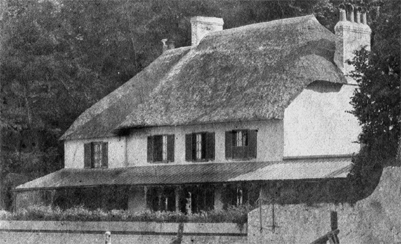
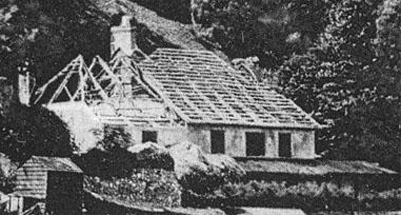
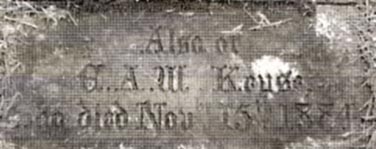
On Saturday 15th November 1884, elderly spinster Emma Keyse was brutally murdered at her home, The Glen — a secluded villa overlooking Babbacombe Bay in South Devon, England. Her skull had been crushed, her throat savagely cut from ear to ear and her body set alight. The house was deliberately ignited in five different places.
John Lee, a 20-year-old Devonshire servant, worked as a footman and gardener at The Glen. On the morning after the crime, suspicion fell swiftly on him.
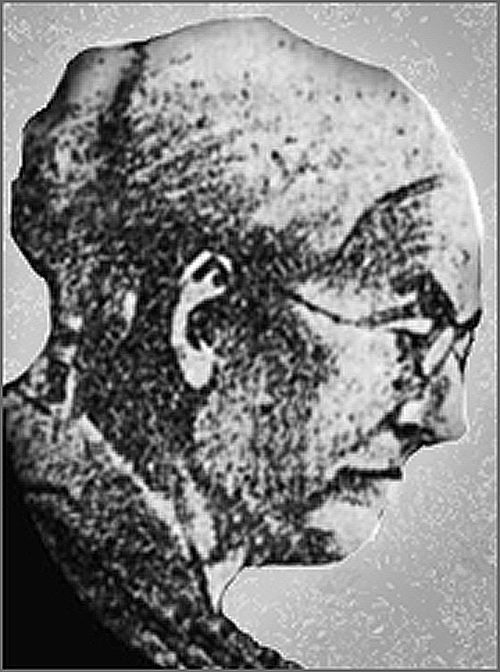
Though there was no direct eyewitness evidence, the circumstantial case was strong. Lee was accused not only of murder but also of arson. His motive, it was claimed, was resentment at a recent wage reduction. He maintained his innocence but contradicted himself repeatedly, and gave misleading statements that hindered the investigation. He had no adequate defence at trial and was found guilty. Mr Justice Manisty, passing sentence, noted Lee’s composure. “Please, my lord,” said Lee, “allow me to say that I am so calm because I trust in my Lord, and he knows that I am innocent.”
The Failed Execution
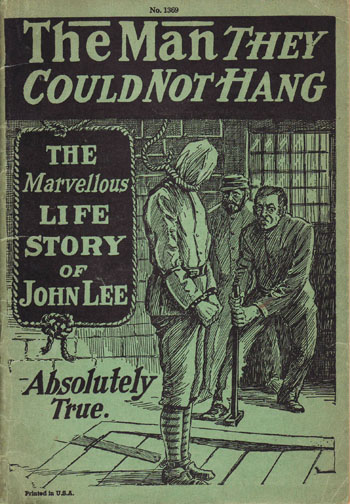
Lee was sentenced to hang on Monday 23rd February 1885. He became intensely religious in prison and faced the gallows with stoic calm. But in a twist stranger than fiction, the execution failed — three times. The trapdoor mechanism jammed repeatedly, refusing to open under Lee’s feet, though it worked perfectly in tests. Warders jumped on the platform, the executioner pulled the lever again and again, but Lee remained unhung.
Incredibly, Lee had dreamt the night before that the gallows would malfunction. At 6 a.m., he recounted this dream to the warders present.
The Home Secretary, faced with growing public concern and theological debate, commuted Lee’s sentence to life imprisonment. His story became legend: he was soon known as The Man They Could Not Hang.
Aftermath and the Rise of the Legend
Lee remained in prison for 22 years. In 1907, after countless petitions and increasing doubt about the safety of his conviction, he was released from Portland Jail.
He became a public curiosity, earning a living touring Britain recounting his ordeal. He married, had two children, but in 1911 he abandoned his family and disappeared. His later life is shrouded in mystery, with unverified sightings in America, Canada, and Australia.
In 1936, the Torquay Herald and Express published an anonymous article that claimed to reveal the “true story” of the murder — supposedly as told by Lee himself. According to this version, Miss Keyse had walked in on a late-night supper party hosted at The Glen. One of the guests — a man of high social standing — killed her in panic. Lee, it was said, helped cover up the crime to protect a friend, inadvertently condemning himself.
The Case Against John Lee
Lee changed his story multiple times. He initially claimed to have slept through the fire, then said he woke to cries. He accused others — Elizabeth Harris and local fisherman Cornelius Harrington — though the latter was soon proven innocent.
He admitted to having threatened Miss Keyse in the weeks prior. He took suspicious actions on the morning of the murder — such as failing to seek her out or raise alarm. Blood was later found on Jane Neck’s nightdress; investigators believe Lee helped her down the stairs after the attack.
Forensic clues — including bloodstains on Lee’s trousers and the location of a missing slipper and stocking — suggest the body was dragged by the arms, likely by one person.
Lee’s lack of remorse, craving for sympathy, and moral inconsistencies — including abandoning his family — cast further doubt on his character.
The Case For John Lee
Despite this, there are lingering questions. He had no obvious motive — nothing was stolen, and he had no clear gain. Why would he commit murder in the hallway, wearing only stockings, rather than in her room or after she slept?
If he was guilty, why didn’t he flee? Compton was just five miles away. Why stay and risk suspicion? And why did he not confess during his religious conversion?
The Case Against Elizabeth Harris
 Elizabeth Harris, the cook, was pregnant at the time — a severe crisis in Victorian society. She admitted she had kept secrets to protect herself, and her testimony became increasingly damning of Lee.
She delayed checking on Miss Keyse for over 30 minutes after raising the alarm, and gave confused, emotional evidence. She cried frequently in court and was suspected by some at the time. She did not attend Miss Keyse’s funeral.
She once exclaimed, upon hearing of Lee’s arrest, “I know you didn’t do it!” Her shifting narrative casts a long shadow, and although she was never charged, speculation has long surrounded her role in the events.
Legacy and Reflection
Stories of the Babbacombe murder, the failed execution and the mysterious afterlife of John Lee fascinated the public then and now. The press made him a folk hero; silent films and books immortalised his story. But beneath the folklore lies a tragedy — of a woman brutally murdered, justice muddied by Victorian sensibilities, and lives destroyed in the aftermath.
“You say you are innocent, I wish I could believe you.”
— Sir Henry Manisty, Judge at Lee’s trial
“They have not told six words of truth – that is, the servants and that lovely step-sister…”
— John Lee, awaiting execution