Keyse v Taverner – The Babbacombe Beach Dispute of 1881–1882
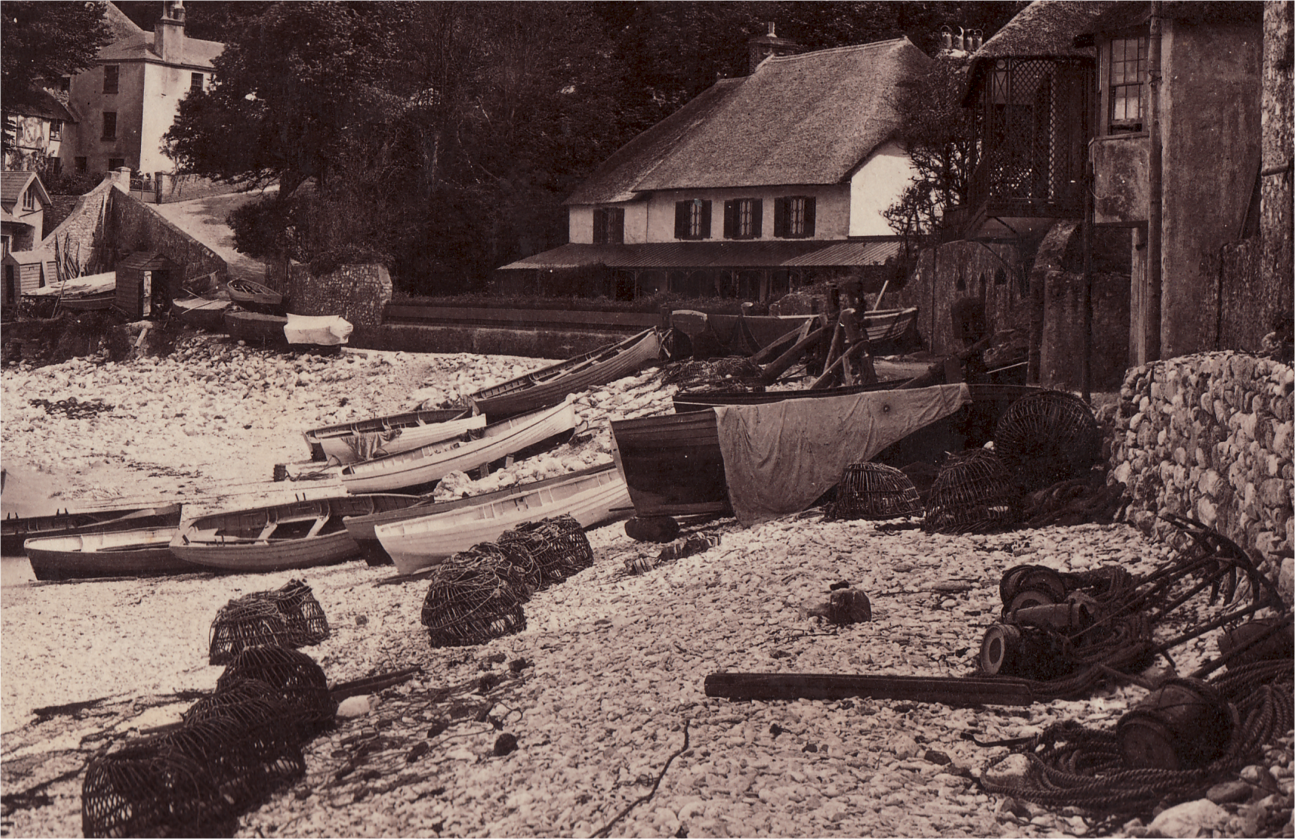
Emma Keyse had leased land in front of her property, on the beach at Babbacombe. She had hoped to have had a uninterrupted vista and access directly on to the beach and into the sea. Sadly, or annoyingly, for her it was not to be. Fishermen were frequently using the strip of land to go about their fishing activity.
Matters came to a head in 1881 and into 1882 in the case of Keyse v Taverner when matters ended in court and in the local news. Mr. Taverner, an innkeeper and fishermen of 20 Fore Street Babbacombe (The Manor Inn, today called Molloys) was taken to court by Miss Keyse.
The Babbacombe Beach Dispute: Keyse v. Taverner
Overview:
This legal dispute, spanning from 1881 into 1882, concerned the rights to use a strip of Babbacombe Beach, specifically regarding the placing of boats and a capstan by local fishermen, and the claims of land use by Miss Emma Keyse, a private resident.
1. Background:
Miss Emma Keyse, residing in a villa overlooking Babbacombe Beach (The Glen), brought action against Mr. Taverner, a local fisherman, for placing a capstan and boats on what she claimed was her private property. The strip of land in question lay between her residence and the sea and had been leased to her by the lord of the manor, Mr. Cary. Local fishermen had long used this land to draw up their boats.
Keyse objected to this usage and had a notice erected asserting her rights. She then removed an old capstan belonging to Taverner, prompting him to file a counterclaim for damages of £3 14s.
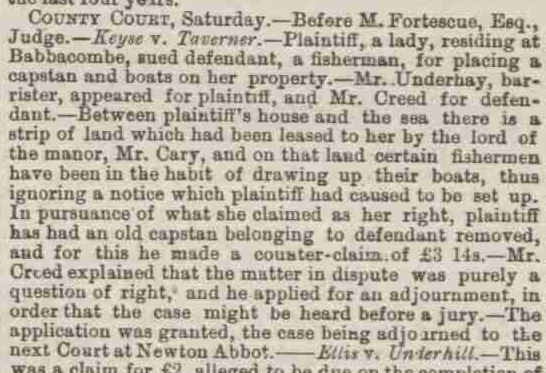
County Court, Saturday. — Before M. Fortescue, Esq., Judge. — Keyse v. Taverner. — Plaintiff, a lady, residing at Babbacombe, sued defendant, a fisherman, for placing a capstan and boats on her property. — Mr. Underhay, barrister, appeared for plaintiff, and Mr. Creed for defendant. — Between plaintiff’s house and the sea there is a strip of land which had been leased to her by the lord of the manor, Mr. Cary, and on that land certain fishermen have been in the habit of drawing up their boats, thus ignoring a notice which plaintiff had caused to be set up. In pursuance of what she claimed as her right, plaintiff has had an old capstan belonging to defendant removed, and for this he made a counter-claim of £3 14s. — Mr. Creed explained that the matter in dispute was purely a question of right, and he applied for an adjournment, in order that the case might be heard before a jury. — The application was granted, the case being adjourned to the next Court at Newton Abbot.
2. Initial Proceedings:
Held in Newton Abbot County Court before Mr. Fortescue, Esq., with Mr. Underhay representing Keyse and Mr. Creed for Taverner.
-
Miss Keyse’s position: Claimed legal right to the land via lease and sought to prevent the beach from being used as a working shore by fishermen.
-
Mr. Taverner’s position: Argued for established customary use by local fishermen and counterclaimed for the removal of his capstan.
The matter was adjourned to be heard before a jury due to its nature as a “question of right.”
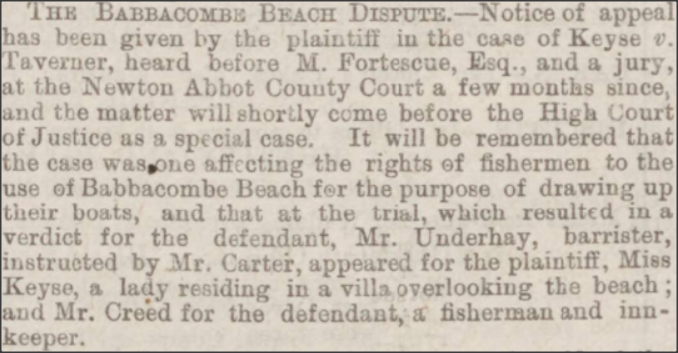
THE BABBACOMBE BEACH DISPUTE. — Notice of appeal has been given by the plaintiff in the case of Keyse v. Taverner, heard before M. Fortescue, Esq., and a jury, at the Newton Abbot County Court a few months since, and the matter will shortly come before the High Court of Justice as a special case. It will be remembered that the case was one affecting the rights of fishermen to the use of Babbacombe Beach for the purpose of drawing up their boats, and that at the trial, which resulted in a verdict for the defendant, Mr. Underhay, barrister, instructed by Mr. Carter, appeared for the plaintiff, Miss Keyse, a lady residing in a villa overlooking the beach; and Mr. Creed for the defendant, a fisherman and innkeeper.
3. Appeal and High Court Hearing:
By March 1882, the case had escalated to the Queen’s Bench Division of the High Court of Justice (before Justices Mathew and Cave).
-
The original case sought damages for trespass by Taverner for placing a boat and capstan on the land.
-
Taverner, in turn, sought damages for the capstan being removed by Keyse.
-
A jury trial had already taken place on 15 October 1881 in Newton Abbot, where a verdict was found for the defendant (Taverner), with the jury affirming his rights under local custom.
The judges ruled that the jury’s verdict had been appropriate and that the rights of the fishermen stood. The appeal was dismissed and the judgment ordered to stand.
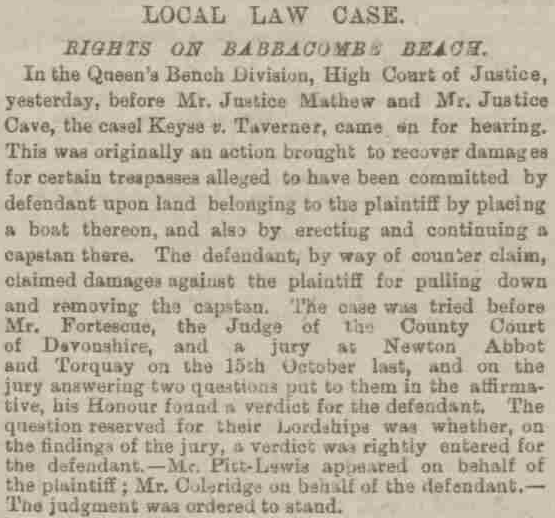
LOCAL LAW CASE.
RIGHTS ON BABBACOMBE BEACH.
In the Queen’s Bench Division, High Court of Justice, yesterday, before Mr. Justice Mathew and Mr. Justice Cave, the case Keyse v. Taverner, came on for hearing. This was originally an action brought to recover damages for certain trespasses alleged to have been committed by defendant upon land belonging to the plaintiff by placing a boat thereon, and also by erecting and continuing a capstan there. The defendant, by way of counter claim, claimed damages against the plaintiff for pulling down and removing the capstan. The case was tried before Mr. Fortescue, the Judge of the County Court of Devonshire, and a jury at Newton Abbot and Torquay on the 15th October last, and on the jury answering two questions put to them in the affirmative, his Honour found a verdict for the defendant. The question reserved for their Lordships was whether, on the findings of the jury, a verdict was rightly entered for the defendant. — Mr. Pitt-Lewis appeared on behalf of the plaintiff, Mr. Coleridge on behalf of the defendant. — The judgment was ordered to stand.
Key Legal Issue:
Whether longstanding use of a beach by local fishermen could override a more recent lease granted to a private individual for the same land.
Outcome:
The courts upheld customary rights of the fishermen, setting a precedent that public use and tradition could outweigh newer private claims—at least where clear evidence of established usage existed.
Legacy of the Case:
Though Keyse v Taverner was, on the surface, a dispute over a strip of beach, its legacy reaches beyond the courtroom. The case highlighted the tension between private ownership and communal tradition—especially in coastal communities where livelihood and landscape have long been intertwined. By siding with the fishermen, the courts affirmed that long-standing local custom could, in some instances, outweigh legal deeds. In Babbacombe, this ruling helped preserve public access to the beach for working men of the sea, and it became a quiet but powerful precedent in similar cases throughout the West Country and beyond.