
Revisiting the John Lee 1936 Confession
In 1936, a Torquay Herald & Express article claimed that John Lee had made a private confession. This claim — known today as the John Lee 1936 confession — shocked those still fascinated by the Babbacombe Murder. The article alleged that Lee had shielded a prominent figure from exposure, casting a new light on the case more than fifty years after the crime.
John Lee 1936 confession article appeared on 6 March 1936, more than half a century after the murder at The Glen and the failed execution of John Lee, an unusual article appeared in the Torquay Herald & Express. Titled plainly but provocatively, it presented what it called the “true story” of the Babbacombe Murder.
The article claimed that Lee, long presumed missing or dead, had confessed privately to a reporter years earlier — not to the murder itself, but to covering for a prominent friend involved in a romantic entanglement that had spiralled fatally out of control.
For researchers, this article occupies a delicate position. It is not a court record, nor is it sworn testimony. It is a piece of journalistic hearsay. Yet it remains significant — both for its content and for the questions it raises about what Lee may or may not have disclosed in later life.
The Article’s Claims
According to the 1936 report — author unnamed, but likely to be journalist Reginald Colwell — the murder of Emma Keyse was not a crime of greed or revenge, but of romantic scandal and fatal secrecy.
The article presents the following narrative:
-
A well-known public figure was allegedly conducting a secret affair with a young woman living at or near The Glen.
-
John Lee was aware of this liaison and had arranged a late-night supper party at the house on 14 November 1884, involving the young woman and her suitor.
-
Miss Keyse discovered the gathering, confronted the individuals involved, and a struggle ensued.
-
During the altercation, Miss Keyse was struck, not fatally at first, but seriously enough that the incident spiralled.
-
The anonymous man and the young woman fled, leaving Lee alone at the scene.
-
In an attempt to protect them — particularly the man’s identity — Lee staged the fire, hoping it would destroy evidence and confuse the investigation.
-
He later refused to name those involved, resulting in his arrest, trial, and near-execution.
The article closes with the statement that Lee never publicly disclosed this story, but confided in the reporter after his release, asking that the truth not be published until after his death.
Source and Provenance
The original John Lee 1936 confession article contains no byline, no interview transcript, and no external verification. However, local press archives and stylistic analysis strongly suggest it was authored by Reg Colwell, a Torquay journalist active from the 1920s to 1940s.
Colwell’s access to Lee is plausible. His career was based in the South West, and he had written previously about historic crimes in Devon. The article contains specific knowledge of The Glen, Emma Keyse, and the layout of the house — details not easily accessible to the general public in 1936.
Whether Lee ever gave such a confession to Colwell remains unprovable. No other journalist or associate confirmed it. No corroborating evidence has surfaced.
The Man They Could Not Hang Was John Lee Guilty ?
“For over half a century the world has thought that John Lee committed the Babbacombe Murder, although he declared to the court: “I am innocent”. To-night, for the first time, the Herald & Express is able to reveal John Lee’s own story of what happened on that terrible night. He had served over twenty years in prison, and as his crime was expiated in the eyes of the law, he stood to gain nothing by lying.”
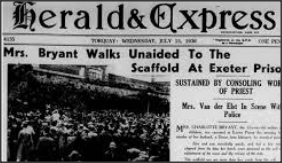
Herald and Express – 1936
“With the death of the late to Mr. Isidore James Carter, the well-known solicitor, of Torquay, who passed away at the advanced age of 87, there disappeared the last personal link with the notorious Babbacombe murder. Mr Carter was the prosecuting solicitor, and it was largely due to his own investigations on the spot that John Lee was arrested and accused of the murder. It was largely to Mr Carter that his conviction was due.
We reveal the story — which will prove that in truth fact is stranger than fiction — on the authority of a man whose name is respected by every citizen of Torquay, but who, for obvious reasons, cannot be identified. Nor, for equally obvious reasons, can any other names would be mentioned, for although none of the principal characters now survives, there may be descendants to whom pain might be caused.
Everybody has heard of John Lee, the man they could not hang, and some inhabitants of the district may have remembered seeing him after his release from prison. A lot of people in Torquay can point out the spot at Babbacombe where the Glen — the house where the murder was committed — stood, but the details of the murder are not well-known to the present generation and must be recited to allow of a proper understanding of the new revelations that we are to make.
John Henry George Lee, whose mother lived at Abbotskerswell, was a young man aged 20 years when, in 1884, he became the centre of worldwide interest. He had been a wild young man. Miss Keyse, a kindly lady whose home was at the Glen, Babbacombe, took a friendly interest in him. He was first employed by her as a page. Even then he was constantly in trouble, but she continued to take an interest in him and got him into the Navy, but after two years they were glad to be rid of him. He seemed unable to stay in any employment. Once he was a porter at Torre station that proved unsatisfactory. After that he entered of the service of Col. Brownlow, but stole his plate and went to prison.
Knowing all this, Miss Keyse, like the devout Christian lady she was, took him back again, all the while looking for better posts for him. His nominal position in the household was that of Butler. The other members of staff were two elderly maids and a young woman named Elizabeth Harris — a half sister of John Lee — who was cook.
On the morning of November 15th, 1884, one of the elderly maids smelled something burning. This was about four o’clock in the morning. She was at once called out and John Lee immediately asked her what was the matter. He then at once appeared, wearing his socks and trousers. At that time the whole place was full of smoke and she could not get down the stairs. He went to her assistance. He held her with his right hand. Later, bloodstains were found on her nightdress where he had touched her in giving assistance.
The maid urged Lee to run to the Cary Arms, just across the road, for help. The Glen stood on the corner of the present Babbacombe Court pleasure ground, facing the beach. But Lee was in no hurry to go. He first walked around the house and when the maid went into the dining-room she found the windows had been broken.
Lee told her he had broken them to let out the smoke. The prosecution alleged that he had deliberately put his fist through the windows to cut his hand so as to be able to account for the bloodstains. But although it was his left hand and arm which had been cut it was from his right hand and arm that the blood came which found its way to the nightdress of the maid who aroused the household.
Finally Lee went across to the Cary arms and summoned help, and coastguards and fishermen came at once to put out the flames. It was then the found that no fewer than five fires had been started in different places, and the whole place was reeking with the smell of paraffin. Later it was proved that nearly a gallon of paraffin had been used to help the fire, in spite of which it did not burned furiously.
In the dining-room was found the body of Miss Keyse. There were wounds on her head, evidently caused by a chopper, her throat was cut. Newspapers had been piled on her body and the whole had been set alight.
It was Lee who went to Torquay to report the matter to the police.
In a drawer they found a bloodstained towel. In another drawer a bloodstained knife. It was obvious that whoever had committed to crime must have been inside the house when the fire was discovered, because all the doors were locked and all the windows were fastened. In the circumstances is not surprising that suspicion fell on the Lee.
At the trial a police witness swore that Lee declared to him, referring to Miss Keyse: “now she is dead they won’t know how it occurred.” His half sister testified against him. She told the court that Lee had told her he intended to set fire to the house and sit on the hill and watch it burn.
The evidence called went to show that Lee went to bed at 11 o’clock PM and the cook and the elderly maids also retired before Miss Keyse, who was writing after midnight in the dining-room, where she was served a couple of cocoa. That cocoa was only half consumed. She was the night attire when found.
Lee was not permitted to give evidence on his own behalf and had no witnesses. He told police that he heard nothing after he retired until he was awakened by the maid shouting “fire.” The oil was kept in a cupboard behind his bed and whoever took the tin must have reached over his bed and disturbed him. But he declared that he heard nobody fetching the oil. And he was wide awake and dressed when the alarm was raised.
The position may be summed up as under:
Points against Lee
He was obviously lying about the window and the oil.
The blood from his right hand made a stain before he broke the window.
The window was broken with his left hand.
The blow which struck Miss Keyse was struck by a man.
Lee was the only man in the house.
Nobody had broken into the house.
Points in Favour of Lee
Lee stood to gain nothing by the death of Miss Keyse.
On the contrary, she was then giving him employment when nobody else would take him and he stood to lose very heavily by her death.
There was nothing of considerable value in the house.
Nothing had been stolen from the house.
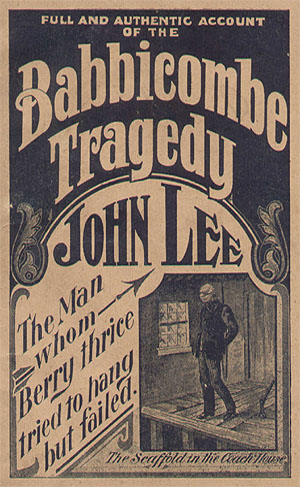
At the trial Lee’s the counsel, Mr. St. Aubyn, addressing the jury, said that at first blush the case was one of the gravest and strongest suspicion against the prisoner, but it was purely one of circumstantial character. Proceeding, he pointed out that the cook was expecting to become a mother, and must have had a lover. He suggested there was nothing to show that is another might not have been the murderer, and although the cook herself might know nothing of the actual deed she would have the greatest inducement to screen her lover, supposing he was the murderer. It will be remembered that the cook was the half sister of Lee who gave evidence against him.
When the jury returned a verdict of “guilty” Lee merely protested that he was innocent. Then the judge proceeded to deliver the sentence. He entirely agreed with the jury. He commented on the calm demeanour of the prisoner throughout the trial and he continued: “he is calm at this moment.”
After sentence Lee put his hands on the rail of the dock, and in a perfectly level voice said: “I am calm, my lord, because of my trust in the lord and because I am innocent.”
On February 11th, 1885, 12 days before the date fixed for his execution, Lee wrote to his sister. In the course of a long letter he said:
“There is no doubt that the truth will come out after I am dead. It must be some very hard hearted persons to let me die for nothing … they have not told six words of truth, that is the servants, and that lovely stepsister, who carries her character with her.”
A few days before the date of the execution he was visited in prison by the Reverend V. Hine, Vicar of Abbotskerswell, and to him Lee stated that he desired to make a statement implicating at least two other people. The Vicar advised him to make his statement in writing and Lee told his sister, who visited him, that he intended to do so. He told her the names he intended to mention. It is believed he did send a statement to the Home Secretary, but a petition for a reprieve was rejected.
It was stated after the death sentence had been commuted to one of penal servitude for life, that before he went to the scaffold he left a written statement, covering two pages, mentioning the name of a woman and some other person. The statement made by the executioner Berry and reported later in this article proves that no such declaration was made by Lee.
The particulars of the three attempts to hang Lee at Exeter prison are generally known. It is not so well known, however, that the horrible proceedings occupied half an hour and that while warders stamped on the trap Lee stood unflinchingly waiting for death, or that he stood on one side while they made the trap work before making another attempt. At the end of half an hour he showed signs of fainting and was taken back to his cell. The under-sheriff went by train to London to report the circumstances to the Home Secretary, who ordered that the sentence be altered to one of penal servitude for life. This sentence was, normally, 20 years. Lee served 22.
While in prison Lee said he had a vision on the night before the date fixed for the execution. An angel, he said, told him he need have no fear and that he would not be executed as he was innocent. He protested his innocence throughout. As he went to the scaffold he said he was not responsible for the death of Miss Keyse.
When he was released, on December 18th, 1907, he returned to Abbotskerswell, where his mother lived, and he was a very good to her. Two years later he married a mental nurse at Newton Abbot. He died in the United States.
These are the facts which the world knows. We are now about to reveal facts which the world does not yet know.
About the year 1890 there stood at the side of an open grave, in a South Devon town, a well-known and local resident and his two sons. The man who had been buried was a public man of the town who had been very well-known, highly respected and very popular throughout South Devon. The young men were, also, in their turn, to become public men in the area. As they were moving away from the grave and the mourners were disbursing their father turned to them and said “we have buried this afternoon the secret of the Babbacombe murder.”
At the time they did not realise the significance of their father’s remark. It was nearly 20 years before they did, but long before that they were aware that their father knew a good many of the secrets of the dead man.
By an amazing coincidence John Lee himself gave them the explanation when he was released from prison.
Lee knew nothing of that funeral when the two young men stood at the open grave. He did not know that the brothers, to whom he went on his release, knew of the existence of a man who had been buried. All he knew was that he felt he had been suffering under the grave injustice for 22 years, he wanted to obtain the redress, and he had decided to talk the matter over with the two men — to have their advice as to what to do to get satisfaction.
The story he told them explained their father’s remark about the secret of the Babbacombe murder and their surprise as the facts were unfolded can be better imagined then described.
He started by declaring that he was not the Babbacombe murderer but that he knew who was, and that he had shielded him for over 20 years, only to discover, on his release from prison, that the murderer was dead.
The name of the murderer he gave. It was the name of the man at whose graveside the men on the opposite side of the table had stood.
Lee went on to explain what happened. The man in question was, he said, well-known to everybody for his public activities. He was much respected. Everybody knew him. What everybody did not know was that he was “carrying on” with a young woman who was known to Lee, and who had access to the servants quarters at the Glen. Thus it was that, with the assistance of Lee, the man in question had arranged a supper party for himself and the woman, and for Lee and another girl, in the kitchen of the Glen on the night of November 15, 1884.
Everything went well. The household was in bed and the party “below stairs” was proving a great success. Apparently they must have made more noise than they bargained for, because some time after midnight, without any warning, the door was thrown open and there stood Miss Keyse in her dressing gown. It was a dramatic moment as described by Lee. He declared that Miss Keyse was livid with the rage. She ordered them out of the house and told Lee to fetch the police.
High words followed. If the police came on the scene the public career of the man who had arranged the party was at an end. Lee at did not know what to do. His own future was anything but bright. Miss Keyse, in a rage, smacked the face of the man. There was a scuffle and a struggle. The man picked up a chopper and the next thing Lee knew was that Miss Keyse was lying dead on the floor.
Naturally everybody was very panic stricken, but according to his own account, Lee kept his head. His idea was that they should make it appear that there had been an attempt to burgle the house and that they should set the place on fire. He argued that, with a thatched roof and the house in such an isolated position, fire would wipe out all traces of what had happened before the flames could be extinguished.
Lee had a very carefully prepared the story that was to be told, and as he was to be the only individual who was to tell any story he did not imagine there would be very much difficulty about it.
So the stage was set. The body was removed to the dining-room, where it was found, the midnight visitors went away, Lee soaked the place with paraffin and in due course set it alight and retired to the bedroom he put his hand through the dining-room window after he was aroused by the cries of the maid who had smelled the fire, and, in so doing cut his arm.
Lee explained how he went to give the alarm at the Cary Arms and afterwards to tell the police about the discovery of Miss Keyse body. He carefully told the story he had prepared and, having told it, never budged from a detail. Even when it was shown that the window was broken from the outside and not the inside he did not tried to explain it. He protested from beginning to end that he did not kill Miss Keyse and even now, after he had completed his sentence, he was here again declaring his innocence through confessing that part he played in the proceedings.
He did not explain who cut Miss Keyse throat.
It was the sole survivor of all the people referred to in this article who told these facts to a Herald and Express reporter and he gave some further particulars.
The man concerned, and who was declared by Lee to be the murderer of Miss Keyse, was known, says our informant, to have been critically ill for a long time after the murder, although nobody at the time — or ever — associated him with the crime. As a matter of fact, he never really recovered, and gradually became demented. He died in a mentally unbalanced condition.
The few people had the slightest idea that he even knew Lee, or Miss Keyse, or the Glen.
But there were a few who knew something, and when, in his madness, he shouted things which the doctors put down in to his state of mind, there were one or two people — our informant’s father was one — who knew what he was referring to, and what had driven him insane.
It was also, said our informant, afterwards discovered that the money for the defence of Lee was provided by the man in question.
Over 20 years ago the writer of this article had occasion to interview James Berry, the executioner, and asked him whether Lee made any statement to him. This is what Berry replied:
“When I went into the cell to pinion him I said: “Well, Lee, do you want to say anything?” Lee shook his head. Then he tapped his breast over his heart and went on: “what I know about this business will remain there. I am innocent.””
Obviously, if even after this lapse of time, names cannot be mentioned, but there is no question whatever that the statements referred to in this article were made by Lee and the other persons mentioned and if Lee spoke the truth — and the other events seem to prove that there was more than “something” in what he said — it looks as though after all this time the world has come to know what really happened at the Glen that night in November over 50 years ago.”
Contradictions and Concerns
The 1936 account, while compelling in structure, poses several problems when compared to the known case record:
-
No evidence of a third party was discovered by police. There were no additional footprints, clothing, or belongings at the scene.
-
Lee, if trying to protect others, gave inconsistent statements rather than silence. His testimony shifted over time — not always in ways consistent with protective self-sacrifice.
-
The notion of a “supper party” at The Glen — a quiet, abstinent, religious household — is difficult to reconcile with the testimony of other servants, especially the Necks and Elizabeth Harris.
-
The fire itself was not a panicked response. There were five separate ignition points, paraffin was used deliberately, and materials were placed with care. This suggests premeditation or, at the very least, composed intent.
If Lee had confessed truthfully, it would raise as many questions as it answered.
Interpretive Value
Despite its unverified nature, the 1936 account holds interpretive interest for several reasons:
-
It reflects contemporary fascination with the case, decades after it had faded from public memory.
-
It provides a possible explanation for Lee’s lifelong claim of innocence — while still accepting his involvement in the cover-up.
-
It may speak to social and political tensions of the Victorian era, where protecting reputations could outweigh legal consequences.
Yet for all its narrative intrigue, the article adds no verifiable facts to the case.
Its publication sparked no new inquiry. The Home Office did not respond. And by 1936, many of the original participants — including Emma Keyse’s household staff and Lee’s own defence team — were deceased.
Was It True?
In the absence of independent confirmation, the 1936 account must be treated with care. It is not included in the official legal record and cannot be presented as fact.
However, it is part of the wider historical landscape of the case — reflecting the myth-making and re-interpretation that often follow unsolved or controversial crimes.
It is preserved here in full and verbatim [see: The 1936 Herald & Express Article] as a historical artefact — not an endorsement.
Lee’s Silence
Perhaps the most revealing detail is what Lee never did.
He never sued for wrongful conviction.
He never petitioned for a formal pardon.
He never wrote a memoir, nor permitted one.
And, apart from the 1936 claim, he never confessed.
His silence — whether strategic, honourable, or fearful — endures.
Read more on The National Archives.