Isidore James Carter, Life and the Babbacombe Murder
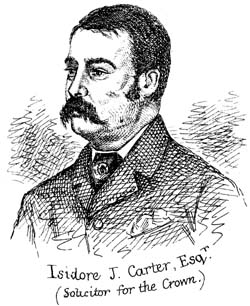 Isidore James Carter played a shadowy but significant role in the Babbacombe Murder case of 1884
The name Isidore James Carter does not appear in bold headlines when discussing the Babbacombe Murder case — the sensational 1884 trial that saw John ‘Babbacombe’ Lee sentenced to death for the murder of Emma Keyse. Yet Carter’s involvement, though discreet and often overlooked, places him close to the legal machinery that turned the young butler into a household name — and a figure of enduring mystery.
Background to the Case
On the night of 15 November 1884, Emma Keyse, a wealthy spinster living at The Glen, her home in Babbacombe near Torquay, was brutally murdered. Her throat was cut, and her body set on fire in what appeared to be an attempt to destroy evidence. A servant in the house, John Henry George Lee, was quickly arrested and charged with the crime.
His trial at Exeter Assizes in early 1885 was swift and circumstantial. Lee proclaimed his innocence throughout but was convicted and sentenced to death — only to survive three failed attempts at hanging due to a malfunctioning scaffold. His sentence was commuted to life imprisonment, and he later became known across the world as “The Man They Could Not Hang.”
Isidore James Carter’s Role
At the time of the murder and trial, Isidore James Carter was a qualified solicitor, aged 36, practising in the Newton Abbot–Torquay–Teignmouth legal circuit. His residence at the time was Wolborough, just a few miles from Babbacombe and the scene of the crime. Newton Abbot, Torquay, and Babbacombe all fell within the same legal jurisdiction, and Carter’s proximity placed him at the periphery of the case from the outset.
Importantly, Carter did not act as John Lee’s defence solicitor. That role was filled by others, and the trial transcripts and legal documents make no mention of Carter formally representing any party in court.
However, his name arises in the surrounding documentation — including divorce proceedings involving his then-wife Ann Miles Carter, which occurred at the exact same time as the murder and trial. Carter’s own affair with a woman named Constance Onslow, and his desertion of his wife in 1882, became the subject of public record in October 1884 — just weeks before the Keyse murder.
Whether coincidence or convergence, the overlapping of these legal narratives — the Carter divorce and the Lee murder case — has led some researchers to question how close Carter’s professional or personal connections might have come to the Lee affair.
Unanswered Questions and Local Talk
Given his legal knowledge and social access, it is not unreasonable to speculate that Carter may have interacted with other solicitors, clerks, constables, or magistrates involved in the Lee case. His previous residence in Teignmouth, and his known connections in Shaldon and Torquay, mean he likely knew of The Glen and its owner, Miss Keyse.
Was Isidore James Carter consulted? Was he present in the court? Could he have advised informally, off the record? We cannot say with certainty — but his placement at the crossroads of time, profession, and geography is undeniable.
Moreover, later reports — including a 1936 article in the Torquay Herald & Express just weeks after Carter’s death — hinted at alternate theories of the murder, including Lee protecting a ‘prominent figure’ connected to The Glen. These whispers, while never formally substantiated, have encouraged some researchers to revisit Carter’s timeline with interest.
A Life in Parallel
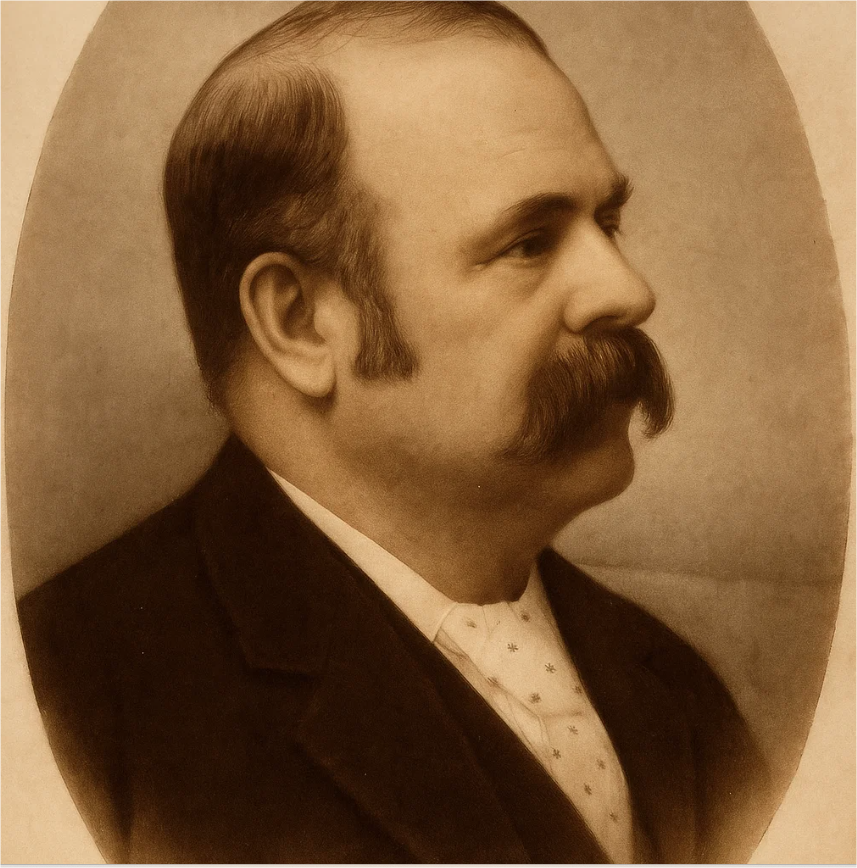 While Lee sat in prison in the years following the failed execution, Carter re-married, resumed his practice, and lived out a full life — dying in 1936, just as public curiosity in the Lee case was beginning to revive. It is a poignant symmetry: the solicitor whose personal scandal unfolded alongside the Babbacombe murder, dying quietly as the man at its centre — John Lee — prepared his final appeals to public memory.
Conclusion: Presence, Not Proof
There is no firm evidence that Isidore James Carter was directly involved in the legal defence or prosecution of John Lee. Yet his presence in the legal and social web of South Devon during the 1880s places him at the edges of one of the Victorian era’s most famous murder cases. Whether he was merely a bystander or something more remains an open question — and perhaps, part of the enduring mystery that still surrounds the Glen, the gallows, and the man they could not hang.
The Story of Isidore James Carter (1848–1936)
Solicitor of Devon – A Life of Status, Scandal, and Survival
Isidore James Carter was born in October 1848 in the cathedral city of Exeter, Devon, into a family of legal and professional standing. His father, Frederick Roger Carter, was a solicitor, and his mother, Elizabeth Henrietta Carter (née Cross), came from a respectable background. The young Isidore was raised in an environment of education, propriety, and middle-class comfort.
By the 1861 census, Isidore, aged 12, was living in Tormoham, a parish that would later become part of Torquay. Though listed in the household as a “servant,” this likely reflected a common Victorian classification for young legal clerks or live-in apprentices — he was most probably already on the path toward a legal career. A decade later, in 1871, he was still in Tormoham, now 22 and listed as a solicitor, residing with his family.
A Respectable Marriage
In July 1872, Isidore married Annie Miles Christophers, a woman of similar social standing, at the Parish Church of Withercombe Raleigh near St. Thomas, Devon. Annie was the daughter of John Christophers, a gentleman, and the marriage was witnessed by several members of the Christophers family, suggesting a union of well-placed households.
The couple settled into life in South Devon. Over the next decade, they resided variously in Torquay, Teignmouth, and Newton Abbot — all fashionable and growing towns, often favoured by the professional classes. They had two sons:
-
Harry Miles Carter, born in 1874 in Teignmouth
-
Edward Carter (recorded as “Goat Edward Carter” in one record, likely a transcription error), born in 1879 in Torquay
By the 1881 census, Isidore was listed as the head of the household in Wolborough, Newton Abbot, with his wife and children. He was established, professionally employed, and appeared to have a comfortable domestic life.
Scandal and Collapse
But by the mid-1880s, the Carter household had unravelled. On 10 October 1884, Annie Miles Carter filed for divorce in the High Court of Justice, Probate, Divorce and Admiralty Division. In a detailed and courageous petition, she accused her husband of adultery and desertion.
The documents reveal that between April and July 1882, Isidore conducted a prolonged affair with a woman named Constance Onslow, who had been staying at Hunter’s Lodge, Shaldon, in South Devon. Annie further alleged that her husband had willfully deserted her, leaving her and their children in April 1882 and remaining absent for over two years.
The case, titled Carter v. Carter, was not contested by Isidore. The court heard oral evidence and, on 19 January 1885, issued a Decree Nisi. Six months later, on 28 July 1885, the marriage was formally dissolved. Annie was granted custody of their two sons, and the court found Isidore guilty of adultery “coupled with desertion.”
A Swift Remarriage
Remarkably, just weeks after his divorce became final, Isidore remarried. The second marriage took place in July 1885 in Bath, Somerset — an unusual location that may suggest an attempt to avoid local scrutiny in Devon. The identity of his second wife is not included in the available material, but the timing raises significant questions: was the new bride Constance Onslow herself?
Whatever the case, Isidore showed resilience. Despite the public scandal, he continued his legal career and lived out his days in the same region of Devon that had both raised and disgraced him.
Later Life
Isidore’s later years were spent in Tormoham and Torquay, where census records from 1891, 1901, and 1911 all place him living comfortably as head of household. He remained in Devon through the early 20th century, witnessing both world wars begin and die down. His estranged wife Annie died in 1916 in Cornwall, aged 72.
Isidore James Carter passed away on 22 February 1936, at the age of 87, in Newton Abbot — the very town where his first marriage had faltered half a century before.
Legacy
Isidore Carter’s life tells the story of a Victorian gentleman who, while born into privilege and armed with a legal career, was not immune to the social consequences of personal failure. His divorce was one of the earlier legal dissolutions initiated by a woman, and it was granted on the strength of her evidence — something still relatively uncommon in the 1880s.
He lived on, maintaining social respectability despite private disgrace, and left behind at least two children whose lives extended the Carter name into the 20th century.
In the High Court of Justice
PROBATE, DIVORCE, AND ADMIRALTY DIVISION
(DIVORCE)
Decree Nisi
Carter A.M. vs Carter I.J.
On the 19th day of January 1885, before the Right Honourable Sir James Hannen, Knight, The President, at the Royal Courts of Justice, Strand, in the County of Middlesex:
The President, having taken the oral evidence of the Petitioner and of the witnesses produced on her behalf in support of the petition filed in this cause, and having heard counsel thereon, the respondent not appearing or defending the suit,
pronounced that the Petitioner had sufficiently proved the contents of the said petition and decreed that the marriage had been solemnized on the 18th day of July 1872, at the Parish Church in the Parish of Withercombe Raleigh in the County of Devon, between Ann (in the certificate of marriage written Ann Miles Carter, then Ann Miles) and Isidore James Carter.
The Respondent Isidore James Carter had been guilty of adultery coupled with desertion of the petitioner for upwards of 2 years without reasonable excuse.
Unless sufficient cause be shown to the court why this decree should not be made absolute within six months, it shall be made so.
It is ordered that Henry Carter and Edward Carter, the children of the marriage, remain in the custody of the Petitioner until further order of the court, and that such children not be removed out of the jurisdiction of the court without its sanction.
Signed:
Stewart & Hannen, Registrar
Decree Absolute
On the 22nd day of July 1885, before the Honourable Sir Charles Parker Butt, Knight, Justice of the High Court:
Referring to the Decree made in this Cause on the 19th day of January 1885, whereby it was decreed that the marriage solemnized on the 18th day of July 1872 at the Parish Church in the Parish of Withercombe Raleigh, County of Devon, between Ann Miles Carter (née Ann Miles) and Isidore James Carter be dissolved by reason of the respondent’s adultery coupled with desertion for two years without reasonable excuse.
No sufficient cause having been shown to the Court why the said decree should not be made absolute, the marriage is now formally dissolved.
Signed:
David Henry Owen, Registrar
In the High Court of Justice
Probate, Divorce and Admiralty Division (Divorce)
Case No. 9801
Petitioner: Ann Miles Carter
Respondent: Isidore James Carter
Filed: 10 October 1884
Solicitors: Church, Rendell & Co., 9 Bedford Row, W.C.
Agent for: W. Creed, Newton Abbot
To the Right Honourable The President
of the Probate Divorce and Admiralty Division of Her Majesty’s High Court of Justice (“Divorce”)
The Ninth Day of October 1884
The Petition of Ann Miles Carter,
of Shaldon, in the parish of Saint Nicholas, in the County of Devon
Sheweth:
-
That your Petitioner was on the eighteenth day of July one thousand eight hundred and seventy two lawfully married to Isidore James Carter, the Respondent in this suit, at the Parish Church of Withercombe Raleigh in the County of Devon.
-
That after her said marriage your Petitioner lived and cohabited with the said Isidore James Carter at Torquay, Teignmouth, and Newton Abbot, all in the County of Devon, and there has been issue of the said marriage two children:
-
Harry Carter, now aged eleven years
-
Edward Carter, now aged six years
-
-
That in the month of April one thousand eight hundred and eighty two, and on other days between that time and the thirty first day of July one thousand eight hundred and eighty two, the said Isidore James Carter at Hunter’s Lodge, Shaldon, in the County of Devon, committed adultery with Constance Onslow.
-
That in and during the months of May, June, and July 1882, the said Constance Onslow was staying at Hunter’s Lodge, Shaldon, as aforesaid, and on divers occasions the said Isidore James Carter committed adultery with her.
-
That in or about the month of April 1882, the said Isidore James Carter wilfully and without reasonable cause deserted your Petitioner, and has lived and continued away from her for two years and upwards, in fact ever since April one thousand eight hundred and eighty two.
Your Petitioner therefore humbly prays:
-
That the Court may be pleased to decree that the said marriage between your Petitioner and the said Isidore James Carter be dissolved.
-
That your Petitioner do have the custody of the children, the issue of the said marriage.
And that your Petitioner may have such further and other relief in the premises as to the Court may seem meet.
Signed:
Ann Miles Carter
Marriage Certificate Copy (attached)
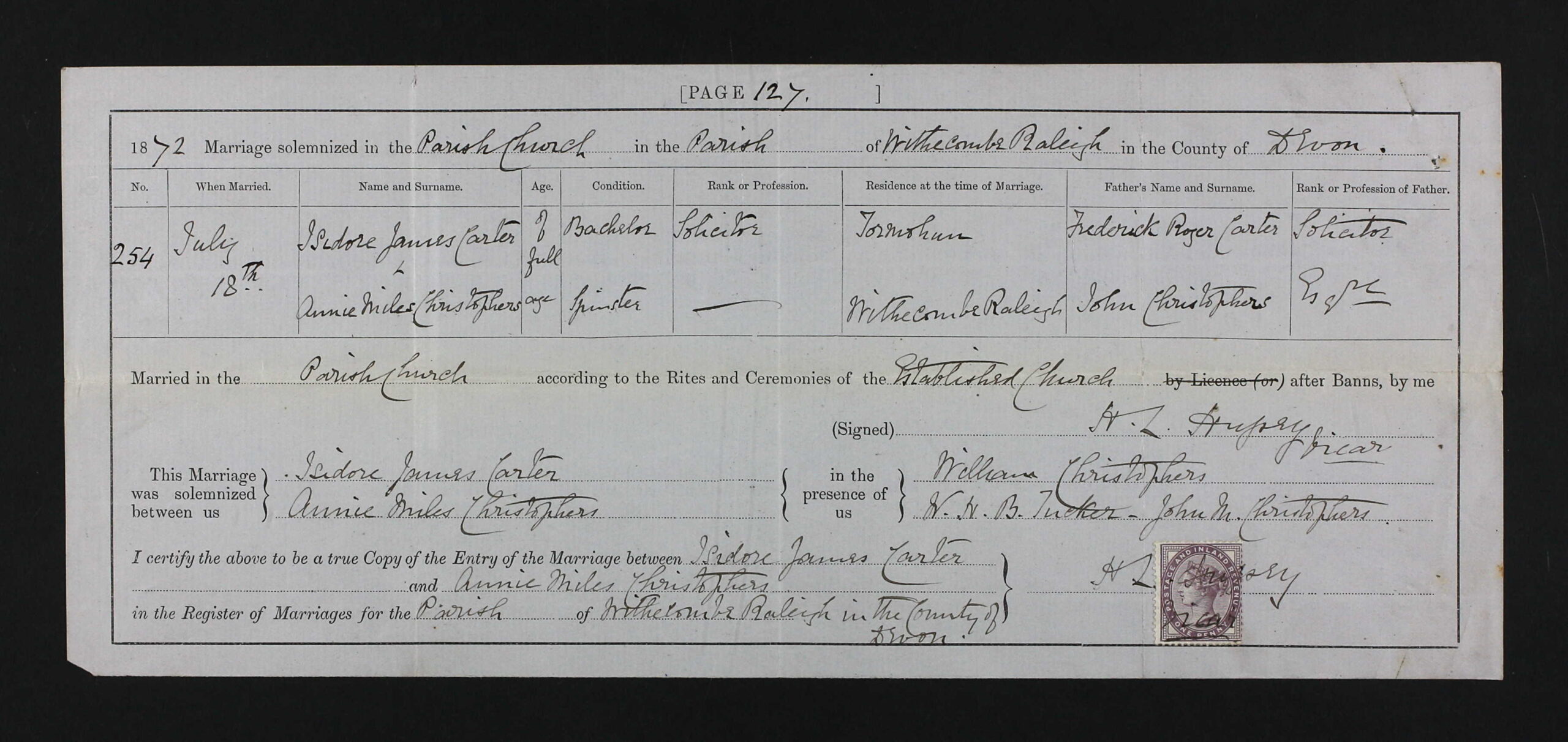 Page 127 of the Register of Marriages for the Parish of Withercombe Raleigh, County of Devon:
-
No. 254
-
Date: July 18th, 1872
-
Groom: Isidore James Carter, full age, bachelor, solicitor, residence: Torrsham
-
Father: Frederick Roger Carter, solicitor
-
-
Bride: Annie Miles Christophers, full age, spinster, residence: Withercombe Raleigh
-
Father: John Christophers, Esq.
-
-
Ceremony performed by: H. J. Dupay, Vicar
-
Witnesses: William Christophers, J. H. B. Tucker, John M. Christophers
-
Signed by both parties
LOCAL DIVORCE CASE (1885).
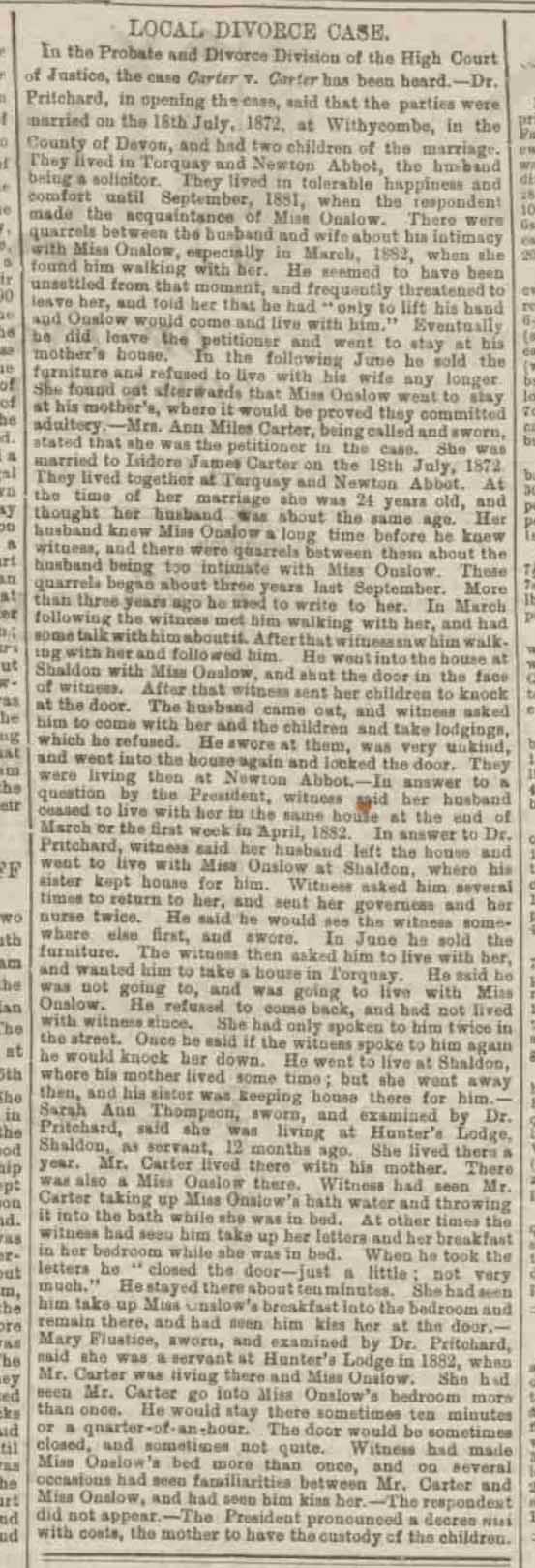
In the Probate and Divorce Division of the High Court of Justice, the case Carter v. Carter has been heard. — Dr. Pritchard, in opening the case, said that the parties were married on the 18th July, 1872, at Withycombe, in the County of Devon, and had two children of the marriage. They lived in Torquay and Newton Abbot, the husband being a solicitor. They lived in tolerable happiness and comfort until September, 1881, when the respondent made the acquaintance of Miss Onslow. There were quarrels between the husband and wife about his intimacy with Miss Onslow, especially in March, 1883, when she found him walking with her. He seemed to have been unsettled from that moment, and frequently threatened to leave her, and told her that he had “only to lift his hand and Onslow would come and live with him.” Eventually he did leave the petitioner and went to stay at his mother’s house. In the following June he sold the furniture and refused to live with his wife any longer. She found out afterwards that Miss Onslow went to stay at his mother’s, where it could be proved they committed adultery. — Mrs. Ann Miles Carter, being called and sworn, stated that she was the petitioner in the case. She was married to Isidore James Carter on the 18th July, 1872, and lived together at Torquay and Newton Abbot. At the time of her marriage she was 24 years old, and thought her husband was about the same age. Her husband knew Miss Onslow a long time before he knew the witness, and there were quarrels between them about the husband being too intimate with Miss Onslow. The quarrels began about three years last September. More than once he swore he had no wish to live with her. In March following the witness met him out walking with her, and he said he was in a disturbed state. Afterwards she saw him with Miss Onslow in Newton Abbot. After the furniture was taken away he lived at his mother’s. He wrote to witness to meet him. She went to Miss Onslow’s house, and saw her and Miss Onslow come out and ask her to the back entrance. She went to the front and asked them to knock at the door. The husband came out, and witness asked him to go home. He said he could not take her to his lodging, which he refused. He swore at them, and was very violent, then went into the door again and locked the door. They were living then at Newton Abbot.—In answer to a question by the President, witness said her husband ceased to live with her in the same house at the end of March or the first week in April, 1882.—In answer to Dr. Pritchard, witness said her husband left the house and went to live with Miss Onslow at Shaldon, where his sister kept house for him. Witness asked him several times to return to her, and sent her servants and her nurse twice. He said he would go as witness somewhere else. He said he was going to live with Miss Onslow. In June he sold the furniture. The witness then asked him to live with her, and would him to take a house in Torquay. He said he was not going to, and was going to live with Miss Onslow. He refused to come back, and had not lived with witness since. She had gone and asked to live with witness. Once he said if the witness spoke to him again he would knock her down. He went to live at Shaldon, where his mother lived some time; but she went away then, and his sister was keeping house there for him.—Sarah Ann Thompson, sworn, and examined by Dr. Pritchard, said she was living at Hunter’s Lodge, Shaldon, as servant, 12 months ago. She lived there a year. Mr. Carter lived there with his mother. There was also a Miss Onslow there. Witness had seen Mr. Carter taking up Miss Onslow’s bath water and throwing it into the bath while she was in bed. At other times the witness had seen him take up her letters and her breakfast in her bedroom while she was in bed. When he took the letters he closed the door—just a little, not very much.” He stayed there about ten minutes. She had seen him take up a tray with breakfast into the bedroom more than once, and had seen him kiss her at the door.—Emma Bearne, sworn, and examined by Dr. Pritchard, said she was a servant at Hunter’s Lodge in 1882, when Mr. Carter was living there with Miss Onslow. She had seen Mr. Carter go into Miss Onslow’s bedroom more than once. He would stay there sometimes ten minutes or a quarter-of-an-hour. The door would be half closed, and sometimes not quite. Witness had made the bed, and he bed more than once, and on several occasions had seen familiarities between Mr. Carter and Miss Onslow, and had seen him kiss her.—The respondent did not appear.—The President pronounced a decree nisi, with costs, the mother to have the custody of the children.
PASSING OF MR. I. J. CARTER.
RETIRED TORQUAY SOLICITOR.
Famous Murder Cases Recalled.

Mr. Isidore James Carter, of 21 Crownhill Park, Torquay, retired senior partner of Messrs. Carter and Fisher, solicitors, died on Saturday at the age of 86. He was engaged in two famous local murder cases—one of them being the Babbacombe murder case which concerned John Lee, “the man they could not hang,” while the other was the case in which Charlotte Winsor was indicted for the murder of several babies.
Mr. Carter was born at Exeter in 1849, and was the son of Mr. Frederick Roger Carter, an Exeter solicitor. The latter opened an office at No. 1 Fleet Street, Torquay, in 1844, and in 1860 he came to live in the town with his family.
When Mr. Isidore James Carter was about 15 he entered his father’s office, and before long was assisting his father.
In the conduct of cases. He became qualified in 1872, and entered into partnership with his father and soon established himself as one of the leading solicitors in this part of the county. In 1909 he took Mr. C. H. Field-Fisher into partnership with him and retired in 1913. While Mr. Field-Fisher was on active service during the War he returned to business, but again retired in 1919. During his retirement he took a great interest in his hobby as a fine art collector—hence the Carter collection of old masters in the Torquay Art Gallery.
Mr. Carter was a keen sportsman, and in his day was regarded as one of the best shots in the county.
The funeral took place at Tor Parish Church on Wednesday.
Following the service, at which the Rev. H. J. Petty (vicar) officiated, and at which Mr. W. Waters presided at the organ, the interment took place at Torquay Cemetery.
Among those present were: Messrs. W. Lockyear (hon. vice-chairman of Torquay Licensed Victuallers’ Association), A. H. Edworthy (treasurer), W. P. McCarthy (vice-chairman), A. B. Stuart (chairman), P. W. Davey (assistant secretary), C. E. Lewis and F. Luxton (members of the Association); Ernest Hutchings (Torquay Coroner), Stanley J. B. Little, D. Frost, R. Newcombe, H. J. Smerdon, V. Upham, N. Hunter, C. K. Crossfield, T. Bowden, W. E. Hancock, S. Bulleid, J.P.; Mr. & Mrs. and Miss Menneer, Mrs. M. C. Little, Mrs. W. Inch, Mrs. Matthew Kerr, Madame Alice Fry, Miss Chave, Mrs. Miller, and Mrs. Bailey.
Wreaths were sent from: The widow; Mrs. Mainwaring and Mr. E. Clerker Onslow; Mr. and Mrs. Guildford Onslow; Rose and Vivian Onslow and children; Miss Vere Onslow; Carly, Dora and Toma; Basil and Marjorie Playne; the staff of Messrs. Carter and Fisher; Ida, Daisy, and Percy Chave; Mr. and Mrs. Ernest Hutchings; Marie Hodges; Mrs. Grey Rollin; Mr. and Mrs. Cox; Mr. W. Cadman; Torquay and District Licensed Victuallers’ Association; Mr. and Mrs. H. J. Smerdon; Dr. and Mrs. Grenier; Mr. and Mrs. and Miss Perkins.