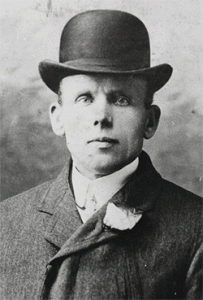
On 18th December 1907, Lee was released from Portland wearing a specially tailored brown suit, an overcoat, and a hard felt hat. The world outside felt like a time warp to him after his twenty-year slumber—trains seemed faster, motor cars now filled the roads, and electric lights illuminated the streets with an unnatural brilliance. So much had changed, and yet, within him, time had stood still.
He experienced an emotional reunion with his mother in Abbotskerswell, remarking, “We were together once more, and I hope we shall remain with each other for many years…” The moment was one of quiet relief, a long-awaited return that neither had fully believed would come. His mother, now elderly and frail, had waited in hope and in prayer through the passing decades.
His father had passed away five years earlier, never witnessing his son’s release.
Though legally free, Lee remained cloaked in the weight of public suspicion and whispered speculation.
Still, he clung to his faith and proclaimed his innocence with unwavering resolve. He stated that his mother knew he was not a murderer and held steadfast to the belief that his life—once wrongly threatened in Exeter—belonged to an innocent man.
For Lee, liberty did not mean forgetting, nor did it erase the past. Instead, it gave him a second chance to live quietly, honourably, and in the light of truth, however dimmed by time.
Just eleven days after his release, the Lloyds Weekly News began serialising Lee’s life story, portraying him as the underdog — a gentle, God-fearing man who had been tantalisingly close to death’s clutches and then banished to a living tomb. The tone was one of redemption and quiet heroism, casting Lee as a figure shaped more by injustice than guilt, more by patience than defiance.
This depiction stood in stark contrast to the way he had been painted in the immediate aftermath of the murder — as a coarse, violent brute, devoid of remorse and wholly deserving of the noose. The shift in public presentation was as remarkable as it was deliberate, feeding into Edwardian fascination with morality, fate, and the possibility of error within the justice system.
The newspaper paid Lee four thousand pounds for his story — a considerable sum at the time, and a reflection of his status as an unexpected folk figure. Yet for all the interest stirred by the series, Lee offered no new revelations. The story was rich in emotion but thin in evidence. His autobiography repeatedly emphasized his innocence, drawing attention to his quiet faith and unshaken denial, but it did not propose an alternative theory or suspect.
He insisted that his hands were clean, asserting that he had slept undisturbed through both Miss Keyse’s murder and the later attempt to set the house ablaze. Whether this was naivety, strategy, or simply his truth, Lee left the mystery as it stood — deepened, not solved.
After his release, Lee reportedly made efforts to clear his name. He remained determined not merely to live out his days in obscurity, but to challenge the legacy that had been thrust upon him. Despite years of silence, he now pursued a form of posthumous justice for himself — one not delivered by courts, but by public opinion and historical record.
He allegedly visited various individuals and actively sought evidence of the rumoured cook’s confession — a supposed admission that cast doubt on the original conviction. In a letter dated 21st January 1908, Lee mentioned his intention to go to London in search of the confession, expressing hope in tracing it back. He believed that somewhere, perhaps among legal papers or forgotten testimony, there might be a signed statement or whispered truth capable of turning the tide. In another letter dated 24th January 1908, he noted, “I have received numerous letters about these confessions,” suggesting he was not alone in his belief that vital evidence had been ignored or suppressed.
Whether the confession existed, or whether it was part of the folklore that had grown around the case, remains uncertain. But Lee’s efforts to investigate it added another dimension to his campaign — one that placed him not only as a survivor of a botched execution, but as an amateur investigator of his own fate.
Two graves, two nations, a lot of research, and one John ‘Babbacombe’ Lee. Between the late 1990s and the mid-2000s, there was finally growing actual documented evidence of what became of The Man They Could Not Hang. With renewed interest from historians and genealogists, details of Lee’s later life — long shrouded in rumour — began to emerge. His story, once thought to have ended in obscurity, reopened for examination under a more forensic, twenty-first-century lens.

Several things are for sure, thanks to revealing archive material. John Lee — the alleged killer who thrice escaped the gallows, who for a brief period in time was the admired personality, the pious underdog elevated by fate — was, in fact, an appalling, ruthless ‘love rat’.
Far from the image cultivated in the Edwardian press, the real John Lee led a tangled and morally dubious private life. Documents and correspondence uncovered in later years paint a picture of a man who deceived multiple women, engaged in overlapping relationships, and left behind a trail of emotional wreckage. He charmed with ease, often presenting himself as a victim of injustice or a man of faith, yet behind the scenes he manipulated sympathies for personal gain.
He fathered children with at least two women under different aliases and repeatedly vanished from their lives without support or explanation. Several of his known relationships ended bitterly, with the women involved later discovering his deceit and history only after he had moved on. While not criminal in the legal sense, Lee’s behaviour towards those who trusted him revealed a cold and calculated streak — one wholly at odds with the passive, prayerful figure often seen in print.
In hindsight, the contrast between the public myth and the private man could not be more stark. The man who claimed divine intervention had spared him from the scaffold proved all too capable of earthly betrayal — not just to the courts and society, but to the women who believed they knew him.
He was also, until the day he finally died, a dreadful liar who fooled his young wife, dragged another strange woman (Adeline Gibbs) into his web of deceit and who kidded the trusting public at large and the American authorities that he was a ‘decent citizen’.
John ‘Babbacombe’ Lee may not have dealt the fatal blow that killed his elderly mistress – but he was for sure a truly despicable man who went to any lengths to gloss his shadowy character.

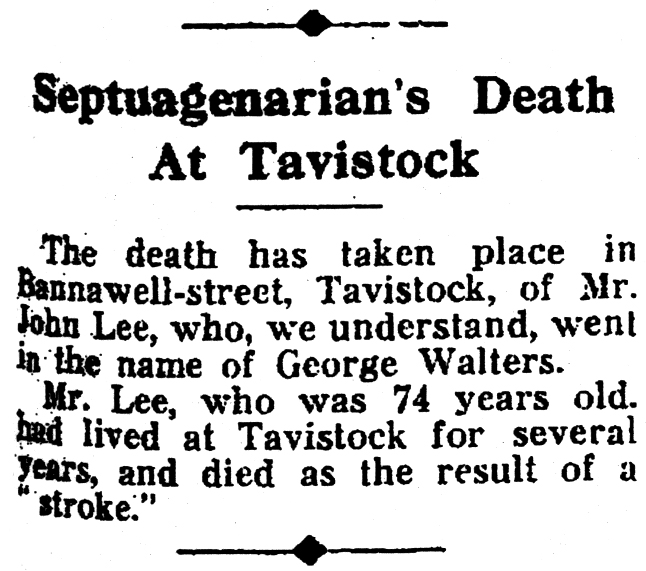
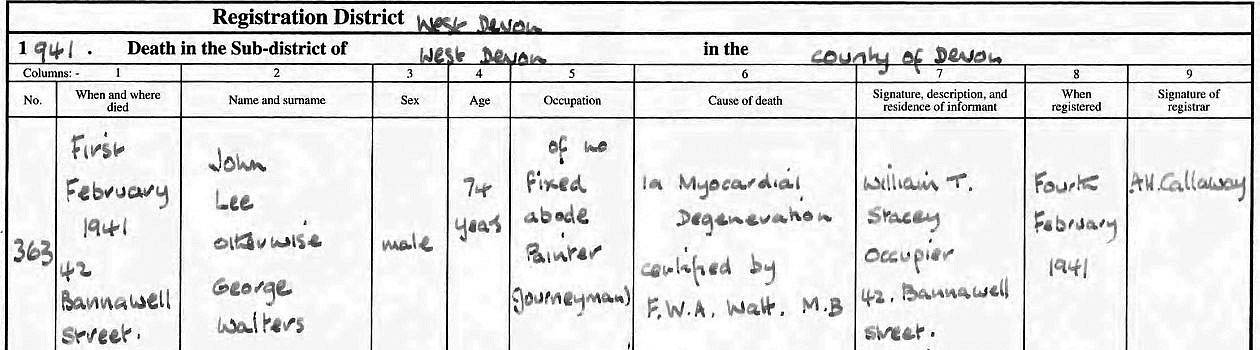
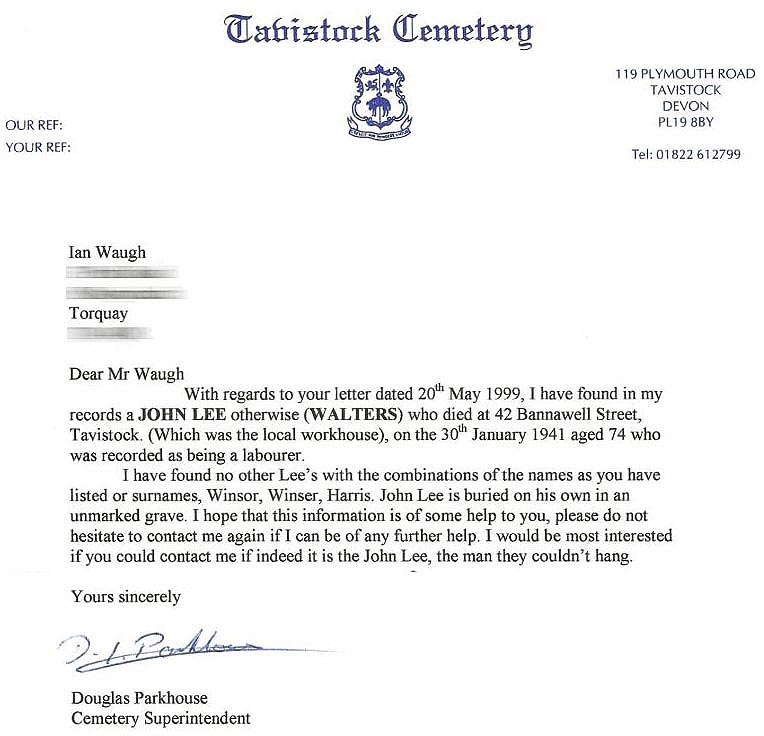
There has been terrific speculation about John Lee’s last years. And, I have to admit that I was totally convinced that I had found John Lee ending his days in Tavistock at the Workhouse, in the South West of England.
I traced an incredibly revealing death certificate — the name, the age, the background all seemed to fit. Quite substantial, even enormous, speculation grew around Tavistock, with local historians and residents alike intrigued by the possibility. For a time, it felt as though the mystery had finally reached a quiet, Devonian conclusion.
There was even an actual burial spot in that town — at Plymouth Road Cemetery — believed by many to be his final resting place. A simple grave, modest and overlooked, seemed to carry the weight of a legend.
I went further still. I spoke to retired cemetery workers, men who remembered the funeral vaguely but with curiosity, and the surviving family of the Tavistock undertakers who had handled the burial. They were utterly convinced — certain, in fact — that the man from the workhouse they buried in 1941 was John ‘Babbacombe’ Lee. One even recalled the whispers in the town at the time: “He’s the one they couldn’t hang, you know.”
It seemed, at long last, that the man whose life had begun in a small Devon village and passed through the horror of the scaffold might also have ended quietly and anonymously back in Devon soil. But, as with everything in Lee’s life, the truth would turn out to be far more complicated.
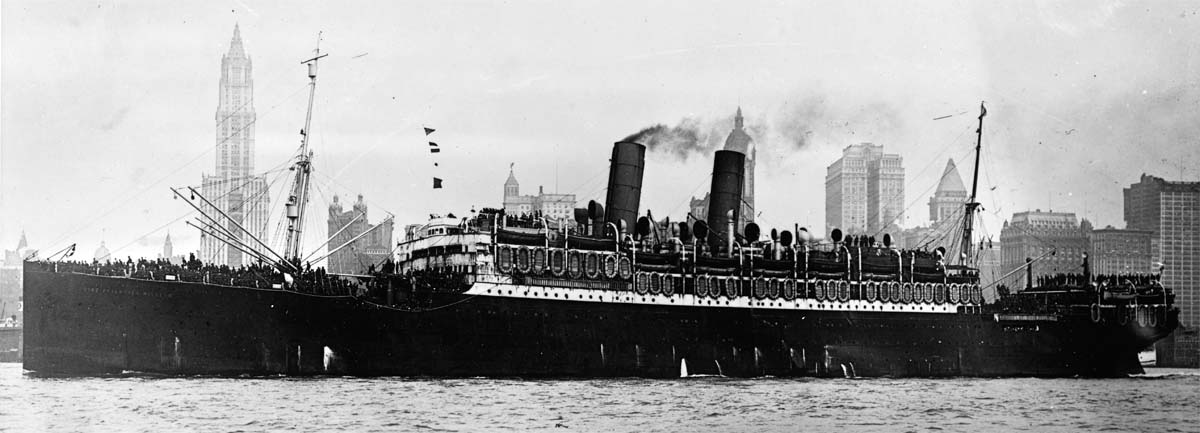
In 1999, when I discovered this death record, certain people who were alive at the time of Lee’s ‘Tavistock Death’ came forward and provided me with compelling evidence that the man they buried at Plymouth Road Cemetery was indeed The Man They Could Not Hang. Their recollections were vivid — not hearsay passed down through generations, but direct memories of the man, the funeral arrangements, and the quiet whispers that surrounded it all.
One former nurse recalled the peculiar interest taken in the man during his final weeks at the workhouse infirmary, while a former gravedigger told me he remembered the unusually large number of mourners for someone who was, officially, just another pauper. Their testimony added considerable weight to the theory I had begun to believe — that John Lee had, after all the myths and mystery, returned to Devon to die.
Once again, the local media was filling up with speculation — fuelled partly, I’ll admit, by my own tip-off to The Tavistock Times. The story took on a life of its own: headlines asked whether the infamous figure from Victorian folklore had truly ended his days in quiet anonymity, buried under a modest headstone in a town few associated with his name.
Radio interviews followed, local historians became involved, and there was even talk of an exhumation to confirm the identity via DNA — though that, thankfully or not, never materialised. For a moment, it seemed Tavistock itself was reclaiming a strange piece of national history — or, depending on your view, becoming the latest chapter in Lee’s enduring enigma.
It was assumed that Lee used a pseudonym (George Walters) during the latter part of his life to disguise his previous experiences – maybe, if true, even John Lee had had enough of the stories and the legend.
In January 1909, Lee married Jessie Augusta Bulled at the Newton Congregational Church. Jessie was the head nurse of the women’s mental ward at Newton Abbot Workhouse — a position of responsibility and quiet dignity, suggesting she was a woman of both compassion and strength. Their union caused considerable local interest, not least because of Lee’s notoriety and the ongoing curiosity surrounding his life after prison.
Lee’s occupation was listed as proprietor of general stores on the marriage licence, with his mother’s address still provided as his residence. It was a modest but respectable claim, hinting at stability and a desire to leave his past behind. The bride wore a blue cloth travelling dress — formal, practical, and carefully chosen — while Lee donned a grey suit adorned with a white carnation, his appearance carefully curated for the occasion.
Lee exuded confidence, walking with poise and offering polite smiles to onlookers. In contrast, his bride appeared somewhat nervous, perhaps overwhelmed by the significance of the moment or the unspoken awareness of her husband’s complicated past. Those who witnessed the ceremony noted the difference in demeanour between them — Lee, ever the performer, and Jessie, more reserved and quietly observant.
Following the ceremony, they immediately headed to the railway station and departed for Durham, where they had reportedly acquired a small business. Lee seemed eager to turn the page. “Fortune has been very kind to me, and I have fared better than expected,” he told a reporter. “I am delighted to have met some of my old friends in Newton Abbot, but if possible, I will avoid returning to this part of the country.”
His words suggested a mixture of gratitude and guardedness — thankful for the kindness shown, but keen to escape the shadows that still clung to Devon soil. For John Lee, the marriage was not just a personal milestone, but an attempt to rewrite his story in a place where fewer people knew his name.
Rumours had always circulated that John Lee had fathered two children. Devon librarian Mike Holgate managed to discover two probable birth records.
John Aubery M. Lee was born between January and March in 1910 in Newcastle, while Evelyn Victoria M. Lee was born between July and September in 1911 in London.
In February 1912, Jessie Lee applied for Parish Relief from the Lambeth Guardians. Mrs. Lee explained that she had two children and her husband had previously worked locally as an exhibit, earning a good salary.
However, in February 1911, he had left her to live in America. He initially sent her some money but later wrote to inform her that he was broke and unable to send any further funds.
If the birth registrations of the children are accurate, then Lee had abandoned his wife when she was four months pregnant and had a baby in her arms. There were rumours that he had deserted his family and fled with a barmaid from the pub.
In 1915, Mary Lee, John Lee’s mother, made her will. She left some belongings to her daughter-in-law Jessie and bequeathed her estate to her son John.
If he was still abroad, she instructed that the sum should be forwarded to him. Mary requested that the money be given to John Lee’s son, Albert Morris John Lee, in the event of John’s death before her.
This convicted killer lived another life after slipping quietly (and illegally) into America where he lived for 28 years before this application. The man who, in 1909, relished the notoriety as The Man They Could Not Hang was miles away from the glare of publicity, his family and the truth.
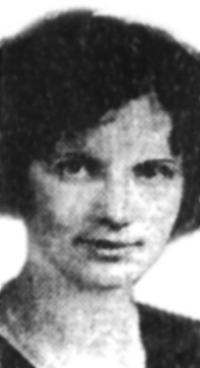
Never really out of the news – this time the tragic story of his daughter, Evelyn, in 1933.
My colleague Mike Holgate is the co-author of a book on this story published worldwide by Sutton. Mike was following yet another lead in 2003 – it was this pointer that led us to find John Lee’s other extraordinary life.
This is where Mike stumbled across a press cutting at the West Country Studies Library, Exeter, England, claiming that this option had been chosen in an unidentified newspaper dated 14 October 1916, “It is reported that John Lee, who served a long sentence of penal servitude after being convicted of the murder of Miss Keyse at Babbacombe, and is now living at Milwaukee, U.S.A., is about to become a naturalised American. He has been in the States five years”.
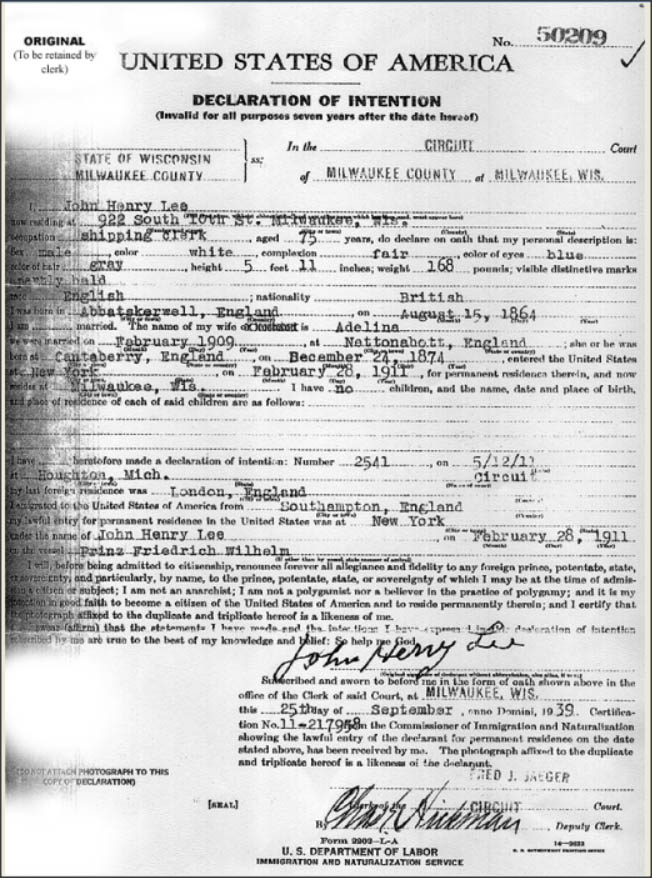
The Winconsin Historical Society conducted a search on our behalf with spectacular results. A record was found – not from 1916 as we had barely dared to hope – but 1939 when John Lee was alive and well at the age of 75.
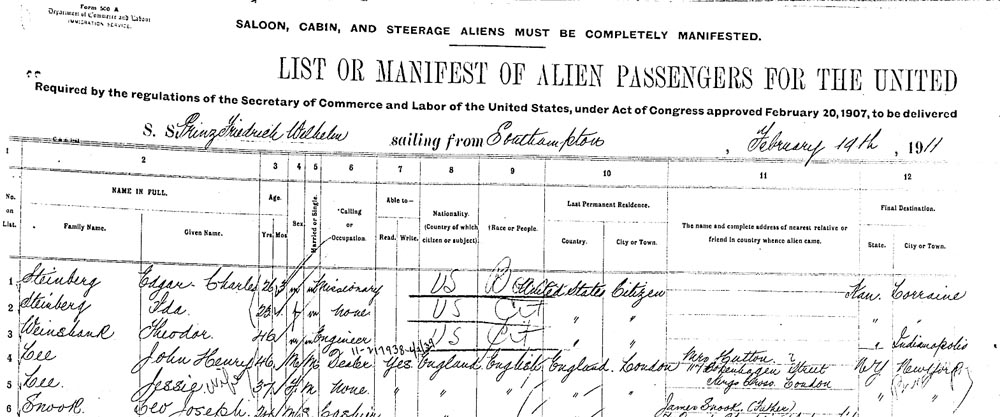
 For some reason, he had left it very late in life before making a Declaration of Intention – the first stage of the legal process in becoming an American citizen. His application confirmed his name as John Henry Lee, born at Abbotskerwell, 15 August 1864, who had entered into marriage at Newton Abbot in 1909 – the date of his wedding to Jessie Bulled. However, he named his ‘wife’ as Adelina, born on Christmas Eve 1874, at Canterbury, Kent.
This lady was Adelina Gibbs – the Miss A Gibb (sic) to whom Lee had sent a Torquay postcard as their illicit relationship was developing while they were working together at the London public house ‘Ye Olde Kings Head’.
The declaration recorded that there were no children from the ‘marriage’ although at the time of the USA 1930 census, John and Adelina had a 15 year-old daughter named Evelyn – a similar name to that given by Jessie Lee to the child born after she had been deserted by her husband. Coincidentally, Londoner Eveline Lee was married early in September 1939, and her name was miss-spelt on the licence as ‘Evelyn’.
Later that month, the father she had never known made his Declaration of Intention to the Milwaukee County Circuit Court — the formal first step towards becoming a naturalised American citizen. It was a significant gesture, suggesting that John Lee, once Britain’s most infamous convict, was now intent on embedding himself permanently into the fabric of a new nation.
The American-born Evelyn, his daughter, was seemingly named after Adelina’s mother. Lee’s partner, Adelina, was the third eldest of nine children born to William Gibbs, a brewer’s cashier, and his wife Evelyn — a respectable, working-class family rooted in quiet routine. At the time of the UK Census conducted in 1901, the Gibbs family were living in the London Borough of Croydon, occupying modest lodgings that reflected their economic stability and aspirations.
Little is known about how John Lee and Adelina first met, or how much she knew of his past — whether she accepted it with full knowledge or whether the truth unfolded gradually. What is clearer is that their union, however unconventional, was functional enough to produce a child and sustain a household on foreign soil. The naming of their daughter after Adelina’s mother suggests an emotional tie to her roots, even as they attempted to build a future far from English scrutiny.
Lee’s decision to formally pursue American citizenship, and to raise a family under a new identity, reflects a complex mix of motivations: reinvention, responsibility, perhaps even redemption. But it also introduces a quieter tragedy — that his daughter would grow up without truly knowing the man behind the paperwork, or the extraordinary tale that once made her father a household name across the Atlantic.
The economic Depression of the Thirties seemingly had little impact on John Lee who at an advanced age was employed throughout the decade as a shipping clerk for a motor vehicle company.
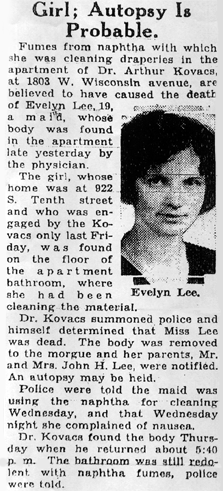
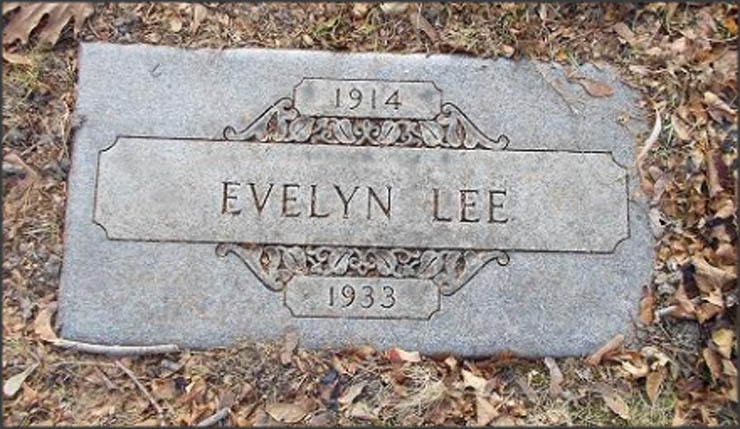
In 1930, he owned his own home valued at $2,300 at 376 5th Avenue, Milwaukee. However, a terrible tragedy was to strike the family when Evelyn Lee died on 12 October 1933. The incident was reported the following day in the Stevens Point Daily Journal:
“A coroner’s autopsy was to be held today to determine the cause of death of Evelyn Lee, 19, a maid who was found dead, apparently from naphtha fumes, in a bathroom of an apartment where she was employed.
The girl was found by Dr. and Mrs. Arthur Kovak when they returned home late yesterday. The bathroom was filled with naphtha which Miss Lee had been using to clean drapes”.
A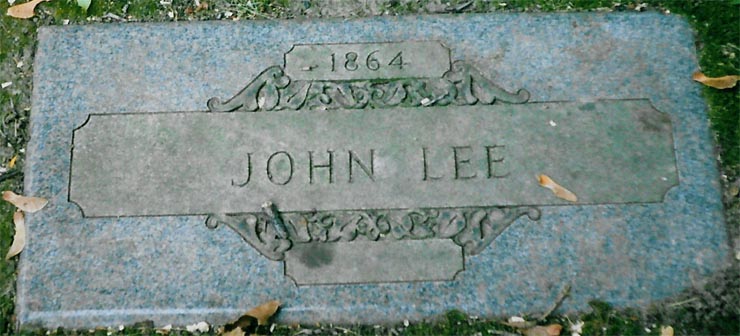 ccording to the Washeka Freeman, 18 October 1933: ‘Two post examinations were performed before the cause of death was definitely determined’. The Coroner, Frank J Schulz recorded a verdict of ‘accidental asphyxiation due to inhaling naphtha fumes’. The death certificate also states that Evelyn Lee’s birth occurred in Milwaukee on 1 August 1914, although no official record could be found to confirm this.
 Reports of John Lee’s demise in Milwaukee in 1933, had been somewhat premature. Perhaps the untimely end of his daughter that year had been somehow misconstrued by sections of the press? At the time of their bereavement, John and Adelina were living in the city at 922 South 10th Street, where they still residing in 1939. Lee did not follow up his Declaration of Intention by formally applying for citizenship, as he was entitled to do so, a minimum of two years later. This led us to assume that he had not survived this period, but the Street Directories of Milwaukee show that the couple had moved to 454 East Holt Avenue by 1941.
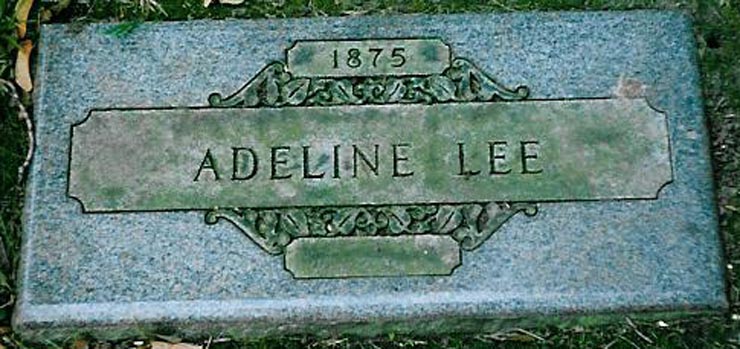
We finally traced Lee’s death and have discovered that The Man They Could Not Hang probably died on the 19 March 1945 at Milwaukee.
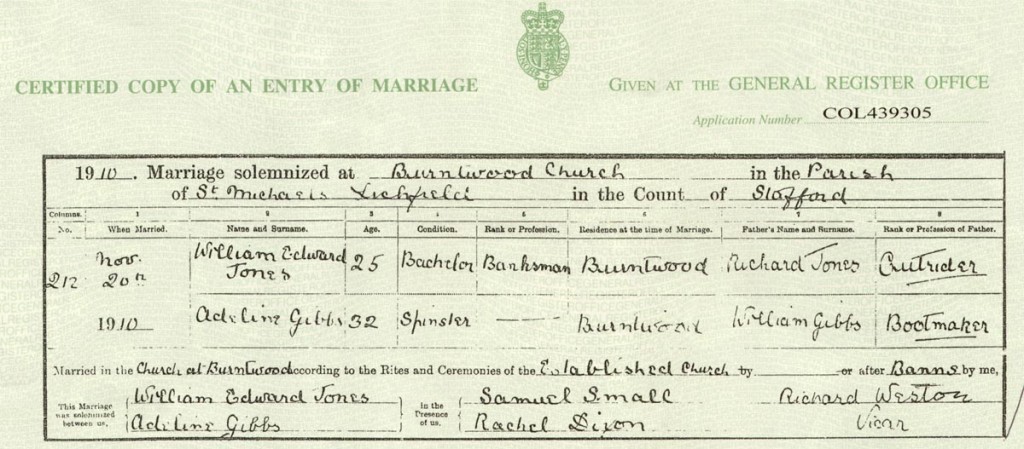
Adelina Lee was recorded residing at the same address as the ‘widow of John H’ in 1947. In actual fact this woman was Adeline Jones (nee: Gibbs) born Penkridge, Staffordshire in 1877. About a year before fleeing Britain with John Lee (and lying to the authorities that she was the real Mrs Lee), Adeline had married the banker William Edward Jones at Litchfield in Staffordshire.
Poor Jessie Augusta Lee – the real Mrs Lee – (nee: Bulled) who so very publicly married John Lee in 1909 retained this name, did not remarry and died in Surrey in 1960.

The story of John Lee inspired two silent films in Australia: one in 1912 and another in 1917. These films closely followed the Lloyds articles, incorporating themes of divine providence and pre-Raphaelite angels hovering over the execution shed. The theory presented in the films was that Elizabeth’s lover had committed the crime, but his motive was largely ignored. Lee was depicted as a working-class hero swept along by overwhelming forces. The films enjoyed widespread screenings in Britain during the 1920s.
In 1971, Dave Swarbrick of the Fairport Convention created a folk hero image of Lee through his album “Babbacombe Lee.” The BBC produced a documentary in 1975 that heavily drew from the Fairport Convention album. Playwright Susan Hagan crafted a play titled “Lamb To The Slaughter” in 1981. Additionally, in 1992, the Lydbrook Players staged a musical about Lee’s story called “John Lee.”
The enduring legend of John Lee ensures that his name remains ingrained in history.