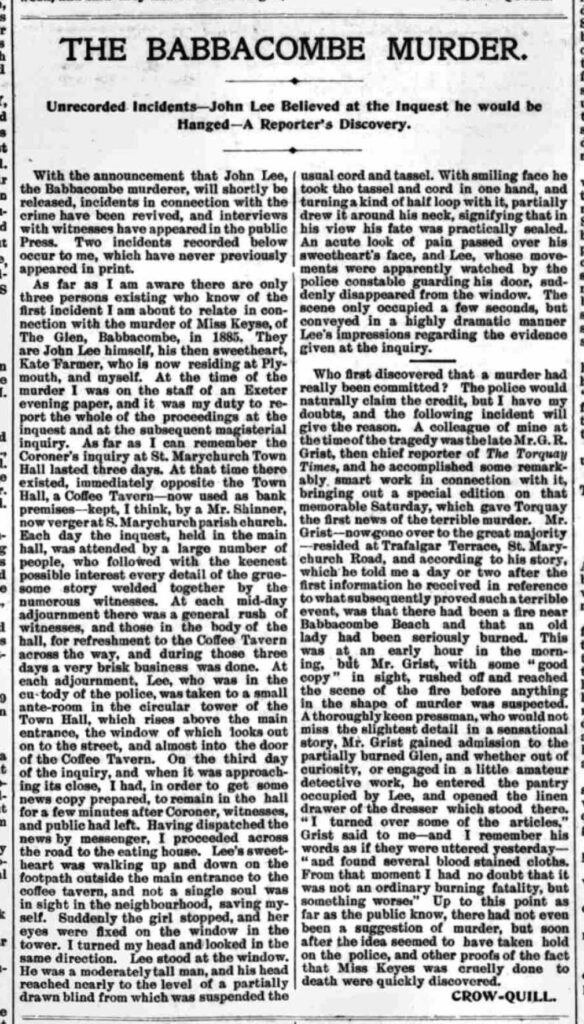
Torquay Times, and South Devon Advertiser – Friday 07 October 1904
Previously Unpublished: Eyewitness Testimony from the John Lee Babbacombe Murder Case
In October 1904, nearly two decades after the events at The Glen, a remarkable article appeared in the Torquay Times and South Devon Advertiser. Written by a journalist who had reported on the original inquiry, it revealed two compelling incidents connected to the John Lee Babbacombe murder that had never previously been published. These first-hand observations add an extraordinary human dimension to a case long shrouded in courtroom transcripts and second-hand reporting.
The first story recounts a deeply emotional scene during the inquest at St. Marychurch Town Hall. Lee, visible from an upper window, reportedly took the tassel from a blind, twisted it into a symbolic noose, and mimed drawing it around his neck. The gesture was seen by his sweetheart, Kate Farmer, who stood on the pavement below. Her visible distress, and Lee’s abrupt withdrawal from the window, gave the moment an eerie intensity—hinting at his resignation to a fate already widely presumed.
The second revelation concerns who truly first discovered that a murder had been committed. Contrary to the official narrative, it was not the police but a local journalist—Mr. G.R. Grist—who uncovered the first evidence of foul play. Entering Lee’s quarters during the aftermath of the fire, Grist found bloodstained cloths in a linen drawer, triggering the suspicion that the fire had concealed a violent death.
These two accounts offer fresh insight into the case and remind us how much of history remains hidden in the margins.
Together, they help us revisit the John Lee Babbacombe murder not just as a legal event, but as a lived experience with witnesses, emotions, and turning points that history nearly forgot.
The Babbacombe Murder
Unrecorded Incidents – John Lee Believed at the Inquest he would be Hanged – A Reporter’s Discovery
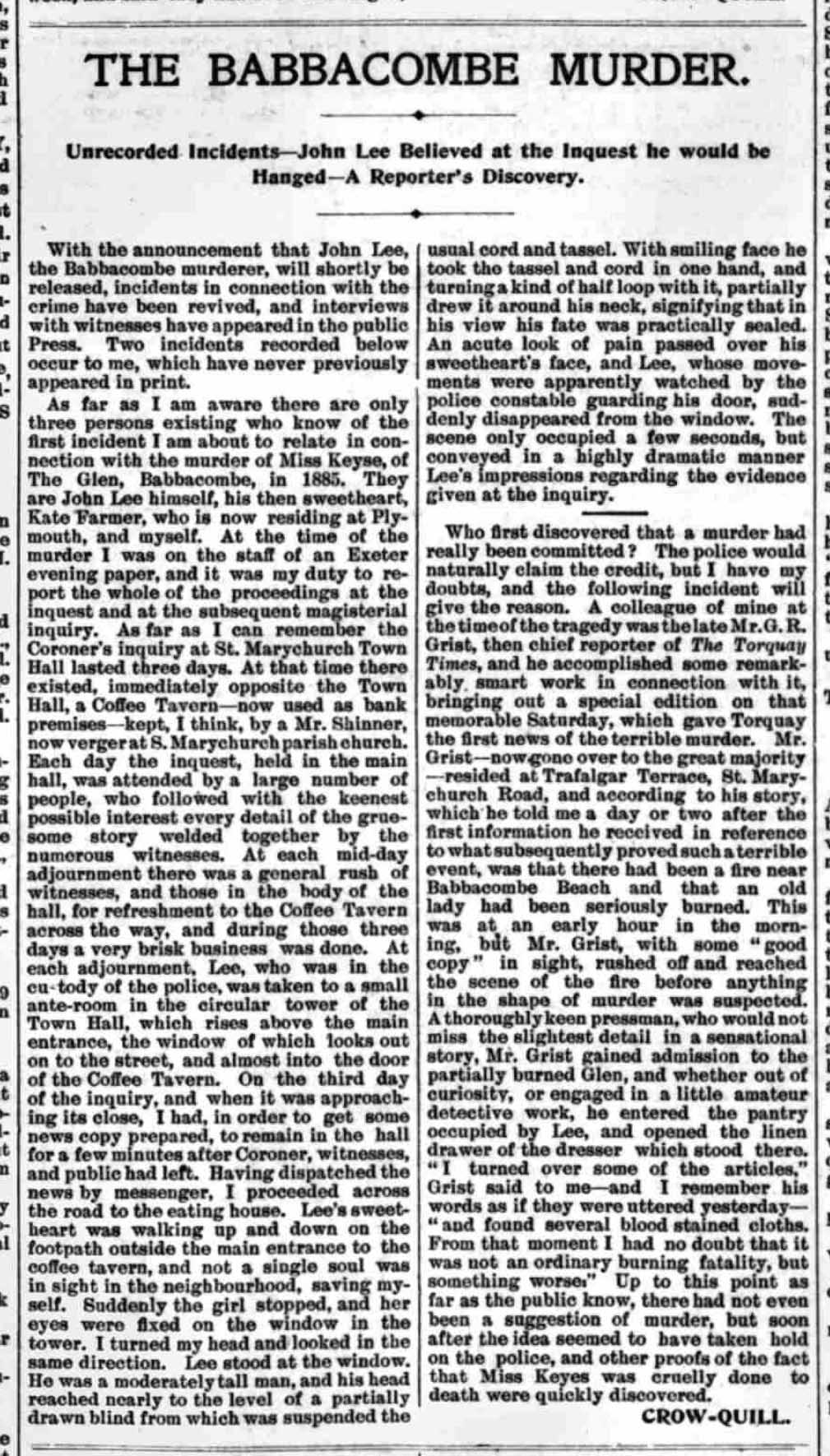
With the announcement that John Lee, the Babbacombe murderer, will shortly be released, incidents in connection with the crime have been revived, and interviews with witnesses have appeared in the public Press. Two incidents recorded below occur to me, which have never previously appeared in print.
As far as I am aware there are only three persons existing who know of the first incident I am about to relate in connection with the murder of Miss Keyse, of The Glen, Babbacombe, in 1885. They are John Lee himself, his then sweetheart, Kate Farmer, who is now residing at Plymouth, and myself. At the time of the murder I was on the staff of an Exeter evening paper, and it was my duty to report the whole of the proceedings at the inquest and at the subsequent magisterial inquiry. As far as I can remember the Coroner’s inquiry at St. Marychurch Town Hall lasted three days. At that time there existed, immediately opposite the Town Hall, a Coffee Tavern—now used as bank premises—kept, I think, by a Mr. Shinner, now verger at St. Marychurch parish church. Each day the inquest, held in the main hall, was attended by a large number of people, who followed with the keenest possible interest every detail of the gruesome story welded together by the numerous witnesses. At each midday adjournment there was a general rush of witnesses, and those in the body of the hall, for refreshment to the Coffee Tavern across the way, and during those three days a very brisk business was done. At each adjournment, Lee, who was in the custody of the police, was taken to a small ante-room in the circular tower of the Town Hall, which rises above the main entrance, the window of which looks out on to the street, and almost into the door of the Coffee Tavern. On the third day of the inquiry, and when it was approaching its close, we had, in order to get some news copy prepared, to remain in the hall for a few minutes after Coroner, witnesses, and public had left. Having dispatched the news by messenger, I proceeded across the road to the eating house. Lee’s sweetheart was walking up and down on the footpath outside the main entrance to the coffee tavern, and not a single soul was in sight in the neighbourhood, saving myself. Suddenly the girl stopped, and her eyes were fixed on the window in the tower. I turned my head and looked in the same direction. Lee stood at the window. He was a moderately tall man, and his head reached nearly to the level of a partially drawn blind from which was suspended the usual cord and tassel. With smiling face he took the tassel and cord in one hand, and turning a kind of half loop with it, partially drew it around his neck, signifying that in his view his fate was practically sealed. An acute look of pain passed over his sweetheart’s face, and Lee, whose movements were apparently watched by the police constable guarding his door, suddenly disappeared from the window. The scene only occupied a few seconds, but conveyed in a highly dramatic manner Lee’s impressions regarding the evidence given at the inquiry.
Who first discovered that a murder had really been committed? The police would naturally claim the credit, but I have my doubts, and the following incident will give the reason. A colleague of mine at the time of the tragedy was the late Mr. G. R. Grist, then chief reporter of The Torquay Times, and he accomplished some remarkably smart work in connection with it, bringing out a special edition on that memorable Saturday, which gave Torquay the first news of the terrible murder. Mr. Grist—now gone over to the great majority—resided at Trafalgar Terrace, St. Marychurch Road, and according to his story, which he told me a day or two after the event, was that the first information he received in reference to what subsequently proved such a terrible event, was that there had been a fire near Babbacombe Beach and that an old lady had been seriously burned. This was at an early hour in the morning, but Mr. Grist, with some “good copy” in sight, rushed off and reached the scene of the fire before anything in the shape of murder was suspected. A thoroughly keen pressman, who would not miss the slightest detail in a sensational story, Mr. Grist gained admission to the partially burned Glen, and whether out of curiosity, or engaged in a little amateur detective work, he entered the pantry occupied by Lee, and opened the linen drawer of the dresser which stood there. “I turned over some of the articles,” Grist said to me—and I remember his words as if they were uttered yesterday—“and found several blood stained cloths. From that moment I had no doubt that it was not an ordinary burning fatality, but something worse.” Up to this point as far as the public know, there had not even been a suggestion of murder, but soon after the idea seemed to have taken hold on the police, and other proofs of the fact that Miss Keyes was cruelly done to death were quickly discovered.
Context and Summary:
By the time this article was published in October 1904, there was considerable renewed public interest in Lee’s case due to growing rumours that he might soon be released from prison. The article reflects this renewed attention and contributes fresh details not previously recorded in print, written by someone who covered the case at the time for an Exeter newspaper.
Key Revelations in the Article:
1. The Tower Window Gesture
-
The writer recalls a deeply personal and haunting moment at St. Marychurch Town Hall during the Coroner’s Inquest.
-
From the street outside, he and Kate Farmer (Lee’s former sweetheart) observed Lee looking out of a small upper window in the circular tower.
-
Lee took the cord and tassel of a blind, mimicked creating a noose, and drew it around his neck — a chilling symbolic gesture indicating he believed his fate was sealed.
-
The writer describes how Kate visibly reacted with pain, and Lee quickly withdrew from the window.
This moment is notable not only for its psychological insight into Lee’s state of mind but also because it was never made public until this article — making it a powerful piece of eyewitness testimony.
2. The First Discovery of the Murder
-
The article challenges the official narrative that police discovered the crime.
-
It credits Mr. G. R. Grist, the then-chief reporter of The Torquay Times, with uncovering evidence of foul play before the authorities.
-
Grist was reportedly first on the scene after hearing there had been a fire at The Glen.
-
On his own initiative, he entered Lee’s pantry, opened a linen drawer, and found blood-stained cloths, which led him to suspect that the fire concealed a violent crime.
-
Grist’s actions reportedly predated any formal police conclusion that a murder had occurred.
This detail significantly revises the accepted timeline of the investigation and showcases the role of local journalism in uncovering truth before officialdom.
Historical Significance:
-
The article contributes rare, contemporaneous insight into both John Lee’s demeanour during the inquest and the early identification of evidence pointing to murder.
-
It also adds depth to our understanding of how the case unfolded in real time — not just through formal testimony but via the lived experiences of those observing and reporting.
Source Details for Citation:
-
Title: Untitled eyewitness account regarding John Lee and the discovery of Miss Keyse’s murder
-
Publication: Torquay Times, and South Devon Advertiser
-
Date: Friday, 7 October 1904
-
Location of events: St. Marychurch Town Hall; The Glen, Babbacombe
-
Subjects: John Henry George Lee, Kate Farmer, Mr. G.R. Grist