Western Times – Tuesday 18 November 1884
THE MURDER AT BABBACOMBE.
—
THE INQUEST.
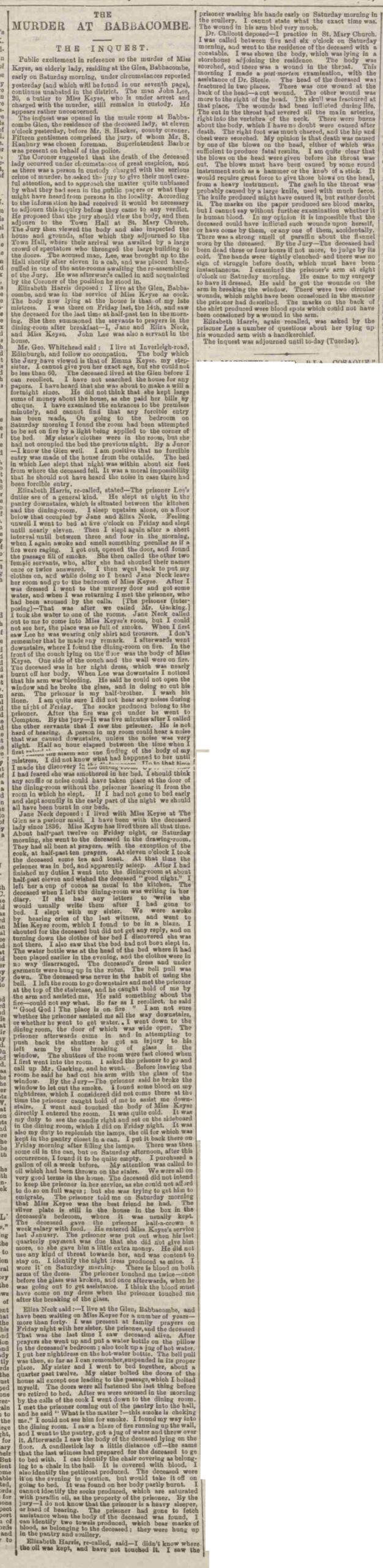
Public excitement in reference to the murder of Miss Keyse, an elderly lady, residing at the Glen, Babbacombe, early on Saturday morning, under circumstances reported yesterday (and which will be found in our seventh page), continues unabated in the district. The man John Lee, 20, a butler to Miss Keyse, who is under arrest and charged with the murder, still remains in custody. He appears rather unconcerned.
The inquest was opened in the music room at Babbacombe Glen, the residence of the deceased lady, at eleven o’clock yesterday, before Mr. S. Hacker, county coroner. Fifteen gentlemen comprised the jury, of whom Mr. S. Hanbury was chosen foreman. Superintendent Baber was present on behalf of the police.
The Coroner suggested that the death of the deceased lady occurred under circumstances of great suspicion, and as there was a person in custody charged with the serious crime of murder, he asked the jury to give their most careful attention, and to approach the matter quite unbiased by what they had seen in the public papers or what they might have heard from persons in the locality. According to the information he had received it would be necessary to adjourn this inquiry before they came to any verdict. He proposed that the jury should view the body, and then adjourn to the Town Hall at St. Mary Church. The Jury then viewed the body and also inspected the house and grounds, after which they adjourned to the Town Hall, where their arrival was awaited by a large crowd of spectators who thronged the large building to the doors. The accused man, Lee, was brought up to the Hall shortly after eleven in a cab, and was placed handcuffed in one of the ante-rooms awaiting the re-assembling of the Jury. He was afterwards called in and acquainted by the Coroner of the position he stood in.
Elizabeth Harris deposed: I live at the Glen, Babbacombe, and was in the service of Miss Keyse on Friday. The body now lying at the house is that of my late mistress. I was there on Friday last, the 14th, and saw her for the last time at half-past ten in the morning. She then summoned the servants to prayers in the dining-room after breakfast—I, Jane and Eliza Neck, and Miss Keyse. John Lee was also a servant in the house.
Mr. Geo. Whitehead said: I live at Inverleith-road, Edinburgh, and follow no occupation. The body which the jury have viewed is that of Emma Keyse, my step-sister. I cannot give you her exact age, but she could not be less than 60. The deceased lived at the Glen before I can recollect. I have not searched the house for any papers. I have heard that she was about to make a will a fortnight since. He did not think that she kept large sums of money about the house, as she paid her bills by cheque. I have examined the entrances to the premises minutely, and cannot find that any forcible entry has been made. On going to the bedroom on Saturday morning I found the room had been attempted to be set on fire by a light being applied to the corner of the bed. My sister’s clothes were in the room, but she had not occupied the bed the previous night. By a Juror: — I know the Glen well. I am positive that no forcible entry was made of the house from the outside. The bed in which Lee slept that night was within about six feet from where the deceased fell. It was a moral impossibility that he should not have heard the noise in case there had been forcible entry.
Elizabeth Harris, re-called, stated—The prisoner Lee’s duties are of a general kind. He slept at night in the nursery downstairs, which is situated between the kitchen and the dining-room. I sleep upstairs alone, on a floor below that occupied by Jane and Eliza Neck. Feeling unwell I went to bed at five o’clock on Friday and slept until nearly eleven. Then I slept again after a short interval until between three and four in the morning, when I again awoke and smelt something peculiar as if a fire were raging. I got out, opened the door, and found the passage full of smoke. She then called the other two female servants, who, after she had shouted their names once or twice answered. I then went back to put my clothes on, and while doing so I heard Jane Neck leave her room and go to the bedroom of Miss Keyse. After I was dressed I went to the nursery door and got some water, and when I was returning I met the prisoner, who had been aroused by the calls. [The prisoner (interposing)—That was after we called Mr. Gasking.] I took the water to one of the rooms. Jane Neck called me out to me to come into Miss Keyse’s room, but I could not see her, the place was so full of smoke. When I first saw Lee he was wearing only shirt and trousers. I don’t remember that he made any remark. I afterwards went downstairs, where I found the dining-room on fire. In the kitchen I saw something lying on the floor—the body of Miss Keyse. One side of the couch and the wall were on fire. The deceased was not quite cold, and the fire had not burned the entire body. When Lee was downstairs I noticed that his arms were bleeding. He said he could not open the door, window and he broke the glass, and in doing so cut his arm. The prisoner is my half-brother. He was without his linen. I am quite sure I did not hear any noise during the night of Friday. The socks produced belong to the prisoner. After the fire was got under he went to Compton. By the jury—It was five minutes after I called the other servants that I saw the prisoner. He is not hard of hearing. A person in my room could hear what was caused downstairs, unless the noise was very slight. Half an hour elapsed between the time when I was first awakened and the finding of the body of the waitress. I did not know what had happened to her until I made the discovery in the dining-room. In that time I had feared she was smothered in her bed, I should think any scuffle or noise could have taken place at the door of the dining-room without the prisoner hearing it from the room in which he slept. If I had not gone to bed early and slept soundly in the early part of the night we should all have been burnt in our beds.
Jane Neck deposed: I lived with Miss Keyse at The Glen as a parlour maid. I have been with the deceased lady since 1836. Miss Keyse has lived there all that time. About half-past twelve on Friday night, or Saturday morning, she went to the deceased in the drawing-room. They had all been at prayers, with the exception of the cook, at half-past ten prayers. At eleven o’clock I took the deceased some tea and toast. At that time the prisoner was in bed, and apparently asleep. After I had finished my duties I went into the dining-room at about half-past eleven and wished the deceased “good night.” I left her a cup of cocoa as usual in the kitchen. The deceased when I left the dining-room was writing in her diary. If she had any letters to write she would usually write them after I had gone to bed. I slept with my sister. We were awoke by hearing cries of the last witness, and went to Miss Keyse’s room, which I found to be in a blaze. I shouted for the deceased but did not get any reply, and on turning down the clothes of her bed I discovered she was not there. I also saw that the bed had not been slept in.
The water bottle was at the head of the bed where it had been placed earlier in the evening, and the clothes were in no way disarranged. The deceased’s dress and under garments were hung up in the room. The bell pull was down. The deceased was never in the habit of using the bell. I left the room to go downstairs and met the prisoner at the top of the staircase, and he caught hold of me by the arm and detained me. He said something about the fire—could not say what. So far as I recollect, he said “Good God! The place is on fire, it is on fire.” I am not sure whether the prisoner asked me if all the way was downstairs, or whether he went to get water. I went down dining room, the door of which was wide open. The prisoner afterwards came in and in attempting to push back the shutters he got an injury to his left arm by the breaking of glass in the window. The shutters of the room were fast closed when I first went into the room. I asked the prisoner to go and call up Mr. Gasking, and he went. Before leaving the room he said he had cut his arm with the glass of the window.
By the Jury—The prisoner said he broke the window to let out the smoke. I found some blood on my nightdress, which I considered did not come there at the time the prisoner caught hold of me to assist me downstairs. I went and touched the body of Miss Keyse directly I entered the room. It was quite cold. It was my duty to see the candle alight and set on the sideboard in the dining room, which I did on Friday night. It was also my duty to replenish the lamps, the oil for which was kept in the pantry closet in a can. I put it back there on Friday night after filling the lamps. There was then some oil in the can, but on Saturday afternoon, after this occurrence, I found it to be quite empty. I purchased a gallon of oil a week before. My attention was called to oil which had been thrown on the stairs. We were all on very good terms in the house. The deceased did not intend to keep the prisoner in her service, as she could not afford to do so on full wages; but she was trying to get him to emigrate.
The prisoner told me on Saturday morning that Miss Keyse was the best friend he had. The silver plate is still in the house in the box in the deceased’s bedroom, where it was usually kept. The deceased gave the prisoner half-a-crown a week salary with food. He entered Miss Keyse’s service last January. The prisoner was put out when his last quarterly payment was due that she did not give him more, so she gave him a little extra money. He did not make any kind of threats towards her, and was content to stay on. I identify the night dress produced as mine. I wore it on Saturday morning. There is blood on both sides of the dress. The prisoner touched me twice—once before the glass was broken, and once afterwards when I was going to call for assistance. I think the blood must have come on my dress when the prisoner touched me after the breaking of the glass.
Eliza Neck said:—I live at the Glen, Babbacombe, and have been waiting on Miss Keyse for a number of years—more than forty. I was present at family prayers on Friday night with her sister, the prisoner, and the deceased. That was the last time I saw the deceased alive. After prayers she went up and put a water bottle on the pillow in the deceased’s bedroom; also took up a jug of hot water. I put her nightdress on the hot-water bottle. The bell pull was then, so far as I can remember, suspended in its proper place. My sister and I went to bed together, about a quarter past twelve. My sister bolted the doors of the house all except one leading to the passage, which I bolted myself. The doors were all fastened the last thing before we retired to bed. After we were aroused in the morning by the calls of the cook I went down to the dining room. I met the prisoner coming out of the pantry into the hall, and he said “What is the matter?—this smoke is choking me.” I could not see him for smoke. I found my way into the dining room. I saw a blaze of fire running up the wall, and I went to the pantry, got a jug of water and threw over it. Afterwards I saw the body of the deceased lying on the floor.
A candlestick lay a little distance off—the same that the last witness had prepared for the deceased to go to bed with. I can identify the chair covering as belonging to a chair in the hall. It is covered with blood. I also identify the petticoat produced. The deceased wore it on the evening in question, but would take it off on going to bed. It was found on her body partly burnt. I cannot identify the socks produced, which are saturated with paraffin oil, as the property of the prisoner. By the jury—I do not know that the prisoner is a heavy sleeper or hard of hearing. The prisoner had gone to fetch assistance when the body of the deceased was found. I can identify two towels produced, which bear marks of use and belonging to the deceased; they were hung up in the pantry and scullery.
Elizabeth Harris, re-called, said—I didn’t know where the oil was kept, and have not touched it. I saw the prisoner washing his hands early on Saturday morning in the scullery. I cannot state what the exact time was. The wound in his arm bled very much.
Dr. Chilcott deposed—I practice in St. Mary Church. I was called between five and six o’clock on Saturday morning, and went to the residence of the deceased with a constable. I was shown the body, which was lying in a storehouse adjoining the residence. The body was scorched, and there was a wound in the throat. This morning I made a post-mortem examination, with the assistance of Dr. Steele. The head of the deceased was fractured in two places. There was one wound at the back of the head—a cut wound. The other wound was more to the right of the head. The skull was fractured at that place. The wounds had been inflicted during life. The cut in the throat had severed all the main arteries, right into the vertebræ of the neck. There were burns about the body, which I have no doubt were caused after death. The right foot was much charred, and the hip and chest were scorched. My opinion is that death was caused by one of the blows on the head, either of which was sufficient to produce fatal results. I am quite clear that the blows on the head were given before the throat was cut. The blows must have been caused by some round instrument such as a hammer or the knob of a stick. It would require great force to give those blows on the head, from a heavy instrument. The gash in the throat was probably caused by a large knife, used with much force. The knife produced might have caused it, but rather doubt it. The marks on the paper produced are blood marks, but I cannot say without further examination whether it is human blood. In my opinion it is impossible that the deceased could have inflicted such wounds upon herself, or have come by them, or any one of them, accidentally. There was a strong smell of paraffin about the flannel worn by the deceased.
By the Jury—The deceased had been dead three or four hours at most, not more, judged by the cold. The hands were tightly clenched; and there was no sign of struggle before death, which must have been instantaneous. I examined the prisoner’s arm at eight o’clock on Saturday morning. He came to my surgery to have it dressed. He said he got the wound on the arm in breaking the window. There were two circular wounds, which might have been occasioned in the manner the prisoner had described. The marks on the back of the shirt produced were blood spots which could not have been occasioned by a wound in the arm.
Elizabeth Harris, again recalled, was asked by the prisoner (as a number of questions) about her tying up his wounded arm with a handkerchief.
The inquest was adjourned until to-day (Tuesday).