Express and Echo – Monday 17 November 1884
THE MURDER AT BABBACOMBE.
FURTHER DETAILS.
THE INQUEST.
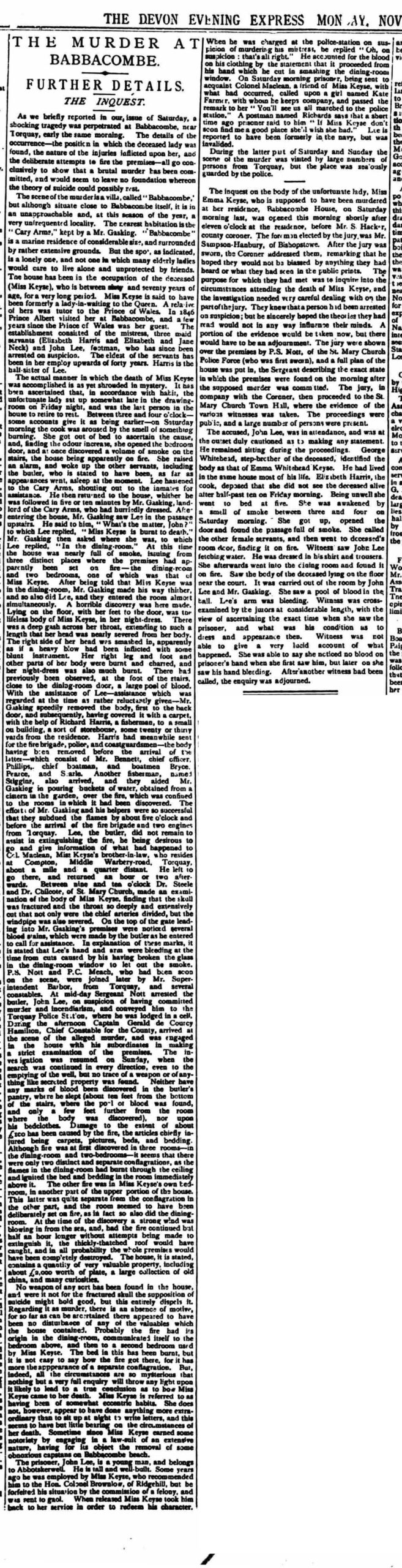
As we briefly reported in our issue of Saturday, a shocking tragedy was perpetrated at Babbacombe, near Torquay, early the same morning. The details of the occurrence—the position in which the deceased lady was found, the nature of the injuries inflicted upon her, and the deliberate attempts to fire the premises—all go conclusively to show that a brutal murder has been committed, and would seem to leave no foundation whereon the theory of suicide could possibly rest.
The scene of the murder is a villa, called “Babbacombe,” but although situate close to Babbacombe itself, it is in an unapproachable and, at this season of the year, a very unfrequented locality. The nearest habitation is the “Cary Arms,” kept by a Mr. Gasking. “Babbacombe” is a marine residence of considerable size, and surrounded by rather extensive grounds. But the spot, as indicated, is a lonely one, and not one to which many elderly ladies would care to live alone and unprotected by friends. The house has been in the occupation of the deceased (Miss Keyse), who is between sixty and seventy years of age, for a very long period. Miss Keyse is said to have been formerly a lady-in-waiting to the Queen. A relative of hers was tutor to the Prince of Wales. In 1846 Prince Albert visited her at Babbacombe, and a few years since the Prince of Wales was her guest.
The establishment consisted of the mistress, three maid servants (Elizabeth Harris and Elizabeth and Jane Neck) and John Lee, footman, who has since been arrested on suspicion. The eldest of the servants has been in her employ upwards of forty years. Harris is the half-sister of Lee.
The actual manner in which the death of Miss Keyse was accomplished is as yet shrouded in mystery. It has been ascertained that, in accordance with habit, the unfortunate lady sat up somewhat late in the drawing-room on Friday night, and was the last person in the house to retire to rest. Between three and four o’clock—some accounts give it as being earlier—on Saturday morning the cook was aroused by the smell of something burning. She got out of bed to ascertain the cause, and, finding the odour increase, she opened the bedroom door, and at once discovered a volume of smoke on the stairs, the house being apparently on fire. She raised an alarm, and woke up the other servants, including the butler, who is stated to have been, as far as appearances went, asleep at the moment. Lee hastened to the Cary Arms, shouting out to the inmates for assistance. He then returned to the house, whither he was followed in five or ten minutes by Mr. Gasking, landlord of the Cary Arms, who had hurriedly dressed.
After entering the house, Mr. Gasking saw Lee in the passage upstairs. He said to him, “What’s the matter, John?” to which Lee replied, “Miss Keyse is burnt to death.” Mr. Gasking then asked where she was, to which Lee replied, “In the dining-room.” At this time the house was nearly full of smoke, issuing from three distinct places where the premises had apparently been set on fire—the dining-room and two bedrooms, one of which was that of Miss Keyse. After being told that Miss Keyse was in the dining-room, Mr. Gasking made his way thither, and so also did Lee, and they entered the room almost simultaneously. A horrible discovery was here made.
Lying on the floor, with her feet to the door, was the lifeless body of Miss Keyse, in her night-dress. There was a deep gash across her throat, extending to such a length that her head was nearly severed from her body. The right side of her head was smashed in, apparently as if a heavy blow had been inflicted with some blunt instrument. Her right leg and foot and other parts of her body were burnt and charred, and her night-dress was also much burnt. previously been observed, at the foot of the stairs, close to the dining-room door, a large pool of blood. With the assistance of Lee—assistance which was regarded at the time as rather reluctantly given—Mr. Gasking speedily removed the body, first to the back door, and subsequently, having covered it with a carpet, with the help of Richard Harris, a fisherman, to a small outbuilding, a sort of storehouse, some twenty or thirty yards from the residence. Harris had meanwhile sent for the fire brigade, police, and coastguardsmen—the body having been removed before the arrival of the latter—which consist of Mr. Bennett, chief officer, Phillips, chief boatman, and boatmen Bryce, Pearce, and Searle.
Another fisherman, named Stiggins, also arrived, and they aided Mr. Gasking in pouring buckets of water, obtained from a cistern in the garden, over the fire, which was confined to the rooms in which it had been discovered. The effort of Mr. Gasking and his helpers proved so successful that they subdued the flames by about five o’clock and before the arrival of the fire brigade and two engines from Torquay. Lee, the butler, did not remain to assist in extinguishing the fire, he being desirous to go and give information of what had happened to C.L. Maclean, Miss Keyse’s brother-in-law, who resides at Compton, Middle Warberry-road, Torquay, about a mile and a quarter distant. He left to go there, and returned an hour or two afterwards. Between nine and ten o’clock Dr. Steele and Dr. Chilcote, of St. Mary Church, made an examination of the body of Miss Keyse, finding that the skull was fractured and the throat so deeply and extensively cut that not only were the chief arteries divided, but the windpipe was also severed.
On the top of the gate leading to Mr. Gasking’s premises were noticed several blood stains, which were made by the butler as he went to call for assistance. In explanation of these marks, it is stated that Lee’s hand and arm were bleeding from severe cuts caused by his having broken the glass in the dining-room window to let out the smoke. P.S. Nott and P.C. Meade, who had been soon on the scene, were joined later by Mr. Superintendent Barbor, from Torquay, and several constables. At mid-day Sergeant Nott arrested the butler, John Lee, on suspicion of having committed murder and incendiarism, and conveyed him to the Torquay Police Station, where he was lodged in a cell. During the afternoon Captain Gerald de Courcy Hamilton, Chief Constable for the County, arrived at the scene of the alleged murder, and was engaged in the house with his subordinates in making a strict examination of the premises.
The investigation was resumed on Sunday, when the search was continued in every direction, even to the emptying of the well, but no trace of a weapon or anything like secreted property was found. Neither have any marks of blood been discovered in the butler’s room, where he slept—about ten feet from the bottom of the stairs, where the pool of blood was found, and only a few feet further from the room where the body was discovered—nor upon his bedclothes. Damage to the extent of about £150 has been caused by the fire, the articles chiefly injured being carpets, pictures, beds, and bedding.
Although fire was at first discovered in three rooms—in the dining-room and two bedrooms—it seems that there were only two distinct and separate conflagrations, as the flames in the dining-room had burnt through the ceiling and ignited the bed and bedding in the room immediately above it. The other fire was in Miss Keyse’s own bedroom, in another part of the upper portion of the house. This latter was quite separate from the conflagration in the other part, and the room seemed to have been deliberately set on fire, as in fact so also did the dining-room. At the time of the discovery a strong wind was blowing in from the sea, and, had the fire continued but half an hour longer without attempts being made to check it, the thickly-thatched roof would have caught, and in all probability the whole premises would have been completely destroyed. The house, it is stated, contains a quantity of very valuable property, including about £3,000 worth of plate, a large collection of old china, and many curiosities.
No weapon of any sort has been found in the house, and were it not for the fractured skull the supposition of suicide might hold good, but this entirely dispels it. Regarding it as murder, there is an absence of motive, for so far as can be ascertained there appeared to have been no disturbance of any of the valuables which the house contained.
Probably the fire had its origin in the dining-room, communicated itself to the bedroom above, and then to a second bedroom used by Miss Keyse. The bed in this has been burnt, but it is not easy to say how the fire got there, for it has more the appearance of a separate conflagration. But, indeed, all the circumstances are so mysterious that nothing but a very full enquiry will throw any light upon it likely to lead to a true conclusion as to how Miss Keyse came to her death. Miss Keyse is referred to as having been of somewhat eccentric habits. She does not, however, appear to have done anything more extraordinary than to sit up at night to write letters, and this seems to have but little bearing on the circumstances of her death. Sometimes since Miss Keyse earned some notoriety by engaging in a law-suit of an extensive nature, having for its object the removal of some obnoxious captains on Babbacombe beach.
The prisoner, John Lee, is a young man, and belongs to Abbotskerswell. He is tall and well-built. Some years ago he was employed by Miss Keyse, who recommended him to the Hon. Colonel Brownlow, of Ridgehill, but he forfeited his situation by the commission of a felony, and was sent to gaol. When released Miss Keyse took him back to her service in order to redeem his character.
When he was charged at the police-station on suspicion of murdering his mistress, he replied “Oh, on suspicion: that’s all right.” He accounted for the blood on his clothing by the statement that it proceeded from his hand which he cut in smashing the dining-room window. On Saturday morning prisoner, being sent to acquaint Colonel Maclean, a friend of Miss Keyse, with what had occurred, called upon a girl named Kate Farmer, with whom he keeps company, and passed the remark to her “You’ll see us all marched to the police station.” A postman named Richards says that a short time ago prisoner said to him “If Miss Keyse don’t soon find me a good place she’ll wish she had.” Lee is reported to have been formerly in the navy, but was invalided.
During the latter part of Saturday and Sunday the scene of the murder was visited by large numbers of persons from Torquay, but the place was zealously guarded by the police.
The inquest on the body of the unfortunate lady, Miss Emma Keyse, who is supposed to have been murdered at her residence, Babbacombe House, on Saturday morning last, was opened this morning shortly after eleven o’clock at the residence, before Mr. S. Hacker, county coroner. The foreman elected by the jury was Mr. Sampson-Hanbury, of Bishopstowe. After the jury was sworn, the Coroner addressed them, remarking that he hoped they would not be biased by anything they had heard or what they had seen in the public prints. The purpose for which they had met was to inquire into the circumstances attending the death of Miss Keyse, and the investigation needed very careful dealing with on the part of the jury. They knew that a person had been arrested on suspicion; but he sincerely hoped the theories they had read would not in any way influence their minds.
A portion of the evidence would be taken now, but there would have to be an adjournment. The jury were shown over the premises by P.S. Nott, of the St. Mary Church Police Force (who was first sworn), and a full plan of the house was put in, the Sergeant describing the exact state in which the premises were found on the morning after the supposed murder was committed. The jury, in company with the Coroner, then proceeded to the St. Mary Church Town Hall, where the evidence of the various witnesses was taken. The proceedings were public, and a large number of persons were present.
The accused, John Lee, was in attendance, and was at the outset duly cautioned as to making any statement. He remained sitting during the proceedings. George Whitehead, step-brother of the deceased, identified the body as that of Emma Whitehead Keyse. He had lived in the same house most of his life. Elizabeth Harris, the cook, deposed that she did not see the deceased alive after half-past ten on Friday morning. Being unwell she went to bed at five. She was awakened by a smell of smoke between three and four on Saturday morning. She got up, opened the door and found the passage full of smoke. She called the other female servants, and then went to deceased’s room door, finding it on fire. Witness saw John Lee fetching water. He was dressed in his shirt and trousers. She afterwards went into the dining room and found it on fire. Saw the body of the deceased lying on the floor near the court. It was carried out of the room by John Lee and Mr. Gasking. She saw a pool of blood in the hall. Lee’s arm was bleeding. Witness was cross-examined by the jurors at considerable length, with the view of ascertaining the exact time when she saw the prisoner, and what was his condition as to dress and appearance then. Witness was not able to give a very lucid account of what happened. She was able to say she noticed no blood on prisoner’s hand when she first saw him, but later on she saw his hand bleeding. After another witness had been called, the enquiry was adjourned.