
By the time John Lee was finally released from prison, he had become something of an Edwardian folk hero. Once the subject of morbid fascination, he now enjoyed a remarkable public rehabilitation—viewed by many as a wronged man, even a symbol of divine intervention. Clean-shaven, suited, and publicly repentant, Lee moved in circles where his infamy brought admiration rather than shame.
In mid-Devon, he courted several women, but it was Jessie Bulled, a nurse at the Newton Abbot Workhouse, who became the focus of his affections—and eventually his wife. Their wedding was deliberately kept low-key, an attempt to avoid the attention of the press. But such attempts were futile; the story of “The Man They Could Not Hang” marrying at last proved irresistible to the media.
Yet what began as a hopeful chapter soon turned tragic. Within a few years, Lee abandoned Jessie—pregnant with their third child—and vanished. He resurfaced in the United States, having travelled with another woman whom he falsely presented as his lawful wife. Together, they raised a child and lived out their lives in quiet obscurity, while Jessie, his real wife, was left behind in Britain, penniless and broken. The last confirmed record of her places her in Lambeth Workhouse.
Lloyd’s Weekly Newspaper, which just a few years earlier had championed the “true story” of John Lee and helped shape his public redemption, now found itself reporting the astonishing turn of events: Lee had abandoned his wife and children, leaving them in desperate circumstances.
MAN THEY COULD NOT HANG.
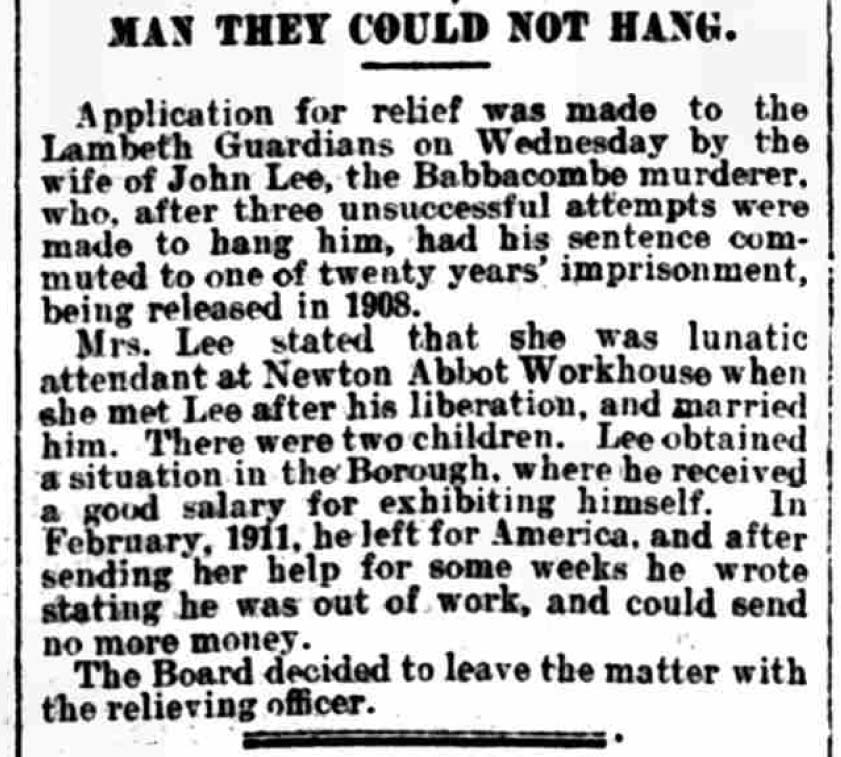
Application for relief was made to the Lambeth Guardians on Wednesday by the wife of John Lee, the Babbacombe murderer, who, after three unsuccessful attempts were made to hang him, had his sentence commuted to one of twenty years’ imprisonment, being released in 1908.
Mrs. Lee stated that she was lunatic attendant at Newton Abbot Workhouse when she met Lee after his liberation, and married him. There were two children. Lee obtained a situation in the Borough, where he received a good salary for exhibiting himself. In February, 1911, he left for America, and after sending her help for some weeks he wrote stating he was out of work, and could send no more money.
The Board decided to leave the matter with the relieving officer.
The Man They Could Not Hang—But Could Walk Away
It is a story steeped in drama, tragedy, and uncomfortable truths. John “Babbacombe” Lee—whose miraculous survival at the gallows once captivated the nation—has re-entered the headlines, not as a figure of pity or divine intervention, but as a man whose actions have cast a long, dark shadow over his once-saintly image.

In 1912, Lloyd’s Weekly Newspaper reported a quietly devastating development: Mrs. Jessie Lee, the wife of John Lee, had applied for relief from the Lambeth Guardians. Her plea, made not for attention but out of sheer necessity, revealed that she had been left destitute—with two children in her care—after her husband abruptly departed for America the previous year.
Jessie’s story is heartbreaking. Employed as a lunatic attendant at Newton Abbot Workhouse, she met Lee following his release from prison in 1908. In spite of his notorious past, she married him, believing in the possibility of redemption. For a time, things looked hopeful. Lee gained employment in the Borough, earning a respectable salary by exhibiting himself—a grim echo of the celebrity he had become after surviving three failed attempts to hang him.
But that fragile domestic life was short-lived. In February 1911, John Lee boarded a ship to America, promising continued support. After a few short weeks of sending money, the letters stopped. One final note claimed he was out of work and could send no more. Then, silence. Jessie was left abandoned, pregnant, and penniless—forced to seek assistance from the very social institutions she once served.
The once-adored Edwardian figure had, it seemed, a darker side. His betrayal of Jessie cast a long shadow over the polished public image he had so carefully cultivated. Whether that shadow stretched all the way back to the brutal murder at Babbacombe remains a matter of speculation. What is certain is that the man the world once refused to hang was all too willing to hang others out to dry.
Just a few years earlier, Lloyd’s Weekly Newspaper had helped rehabilitate Lee’s image by serialising his so-called “true story,” portraying him as the innocent victim of a failed justice system, spared by divine will. That narrative helped to shape public perception—and yet now, the same paper found itself covering the quiet collapse of that legend.
This story, then, is not only about a man who survived the gallows. It is about the woman he left behind, the myth he helped build, and the uncomfortable truth that even miracles can have a sting in their tail. Jessie’s application for relief is more than a personal tragedy—it is a footnote to history that asks us to reconsider what we celebrate, and who we choose to forgive.
More about Jessie Lee here.